Most people are familiar with the hedonic treadmill — the psychological phenomenon where you achieve something you’ve been working toward, feel good about it for a few weeks, and then return to exactly the emotional baseline you started from. New job, same anxiety. New relationship, same loneliness. New goal, same restlessness.
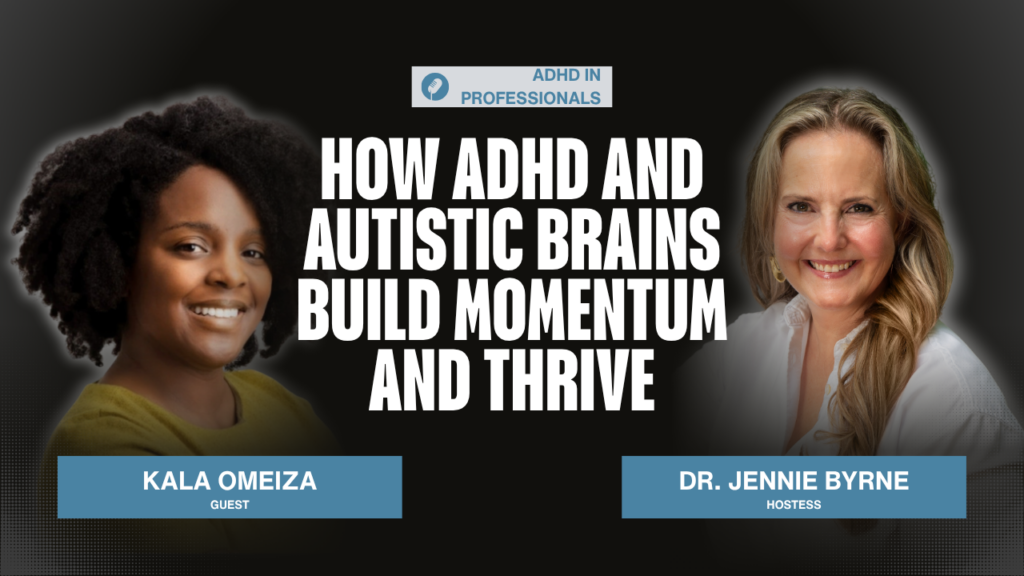
Kala Omeiza spent years watching this pattern in research participants as a clinical study coordinator — and recognizing it in herself. She’s a neurodiversity advocate, author of three books on autism, Fulbright Fellow, Oxford graduate, and someone who wasn’t diagnosed as autistic until age 24. When she finally understood how her own brain worked, she took a concept from the business world and applied it to her nervous system — and called what happened the hedonic flywheel effect.
I sat down with her to talk about what that means, why it matters for people with ADHD and autism specifically, and what it looks like to give yourself permission to follow your interests instead of fighting them.
The difference between a treadmill and a flywheel.
The hedonic treadmill is the cycle of chasing the next thing — the promotion, the relationship, the degree — that returns you to your baseline rather than building something cumulative. You’re expending energy constantly and going nowhere new.
A flywheel is different. In business, a flywheel is a self-reinforcing cycle where each action builds momentum that makes the next action easier. Amazon’s flywheel: more sellers bring more customers, more customers attract more sellers, lower costs enable lower prices, which bring more customers. The energy compounds rather than dissipates.
Kala’s insight was applying this to her own life. After her diagnosis, when she stopped trying to force herself into paths that didn’t fit her brain and started following her actual interests — even when those interests seemed unproductive or niche — something shifted. Following her interest in reading led to joining book clubs. Joining book clubs led to noticing that no fiction books existed about Black autistic girls. Noticing that gap led to writing one. Writing one led to new relationships, new opportunities, new community. The flywheel was spinning.
Each small interest, pursued without self-judgment, generated its own momentum. And momentum, unlike discipline, doesn’t require constant re-investment.
Why this is specifically relevant to ADHD and autistic brains.
The ADHD interest-based nervous system is a concept that comes up constantly in my clinical work. For people with ADHD — and for many autistic people as well — the nervous system is exquisitely responsive to interest, passion, and novelty. When the brain is genuinely engaged with something it cares about, the focus, the energy, and the output can exceed what most neurotypical brains can produce.
The inverse is equally true: tasks that don’t engage the ADHD interest-based nervous system feel not just unpleasant but genuinely neurologically difficult. This isn’t a discipline failure. It’s a different operating system.
Most of the professional world was designed for a nervous system that can modulate attention on demand — that can redirect focus away from what’s interesting and toward what’s required, reliably and repeatedly. For people with ADHD or autism, this modulation is harder, more costly, and more exhausting.
What Kala discovered — and what the hedonic flywheel concept captures — is that working with the nervous system rather than against it doesn’t limit output. It redirects it. She has written three books. She built and ran a Fulbright-funded startup. She founded a nonprofit. She launched a boutique home care agency. She found her husband. None of this happened by forcing herself through interest-mismatched paths. All of it happened by following what genuinely lit her brain up and letting that momentum compound.
The backslide and why it matters.
Kala and I noticed the same pattern from different angles. When people get anxious — about the economy, about their career, about the future — they tend to contract. They stop the book club. They stop the side project. They stop following the niche interest. They go all in on the nine-to-five and nothing else.
The problem is that this contraction, which feels like safety, often produces the opposite of what it promises. When you stop following your interests and start forcing yourself back into the box, the hedonic flywheel slows. And the treadmill starts up again. The depression and anxiety that were already present — which the interest-based activity was genuinely managing — come back without the counterweight.
This is something I see in clinical practice too. For ADHD brains in particular, the structure of a full-time job that doesn’t engage the nervous system, plus the elimination of interest-based outlets, plus the accumulated stress of an anxious cultural moment, is a recipe for deterioration. The prescription that feels responsible is often the one doing the most harm.
What Kala says to people who want to start but are waiting for the right time.
You don’t need more time. You need to use the time you already have.
An audiobook on the commute. A podcast about something you’re genuinely curious about — not useful, not career-relevant, just interesting — while doing tasks that don’t require full attention. A weekly five-minute check-in with yourself: what did I learn this week? What do I want to explore? Who do I want to talk to because of it?
Most people are waiting for the extended uninterrupted window that will let them fully invest in their interests. Kala’s experience — and the experience of most people she’s worked with — is that the window doesn’t produce the magic. The small consistent investment does. The flywheel doesn’t need a running start. It needs a first push.
She also offers a reframe that I find genuinely useful clinically: you don’t have to choose between the lucrative career and the thing you actually care about. Most people don’t have to blow up their life to follow their nervous system’s inclinations. They have to give those inclinations a little time, consistently, and see where the momentum leads.
For people still wondering if they have ADHD or autism.
Kala didn’t get her diagnosis until 24. She spent years studying psychology, studying autism, studying neurodiversity — and not seeing herself in the clinical descriptions. What finally made it click was understanding one specific pattern: the constant chasing, the returning to baseline, the drain of trying to engage in things that her nervous system wasn’t built for.
If that pattern sounds familiar — if you’ve spent your career compensating for a nervous system that works differently from how your environment demands — an assessment is where the picture gets clearer.
Constellation PLLC serves patients across 26 states. Reach out via the contact form at constellationpllc.com.
Kala’s books and work are available at her website — link in comments. Her nonprofit, I’m Heard, focuses on ending the stigma of mental illness in underserved communities. Her boutique home care agency serves older adults and those with developmental disabilities throughout the Research Triangle in North Carolina.
Grab your copy of ADHD in Professionals: Embrace Your Brain here: https://www.amazon.com/dp/B0GZ12GGTV
📌 Kala Omeiza: https://kalaomeiza.com/
📌 I’m Heard nonprofit: https://imheard.world/
📌 Constellation PLLC: constellationpllc.com
Dr. Jennie Byrne, MD, PhD is a neuroscientist, psychiatrist, and author whose work explores human behavior, mental health, and ADHD in high-achieving adults. In her latest book, “ADHD in Professionals: Embracing Your Brain,” she offers an honest, empowering look at how ADHD shows up in physicians, executives, entrepreneurs, and other professionals—and how they can better understand and work with their brains.
A board-certified psychiatrist with an MD/PhD in neuroscience, Dr. Byrne has built her career at the intersection of clinical care, leadership, and innovation. She is known for her clear, pragmatic voice on topics including ADHD, burnout, stigma, and the future of mental health care.
Dr. Byrne is also a sought-after speaker and thought leader committed to helping professionals navigate mental health with insight, candor, and compassion. Learn more at www.constellationpllc.com.