A professional paces the office. He fidgets, jumps between tasks, and keeps moving so everyone can see how hard he is working. His organization rewards it. Underneath all that motion, he is masking ADHD, and the effort is wearing him down.
Filani Ademuyiwa Oluwaseun met this man while visiting his workplace in Nigeria. Filani is the founder of BrainFirst Nigeria and an adult ADHD and neurodiversity specialist who approaches ADHD through an African lens. Their work focuses on how environment shapes awareness, diagnosis, and the messages people absorb about their own minds.
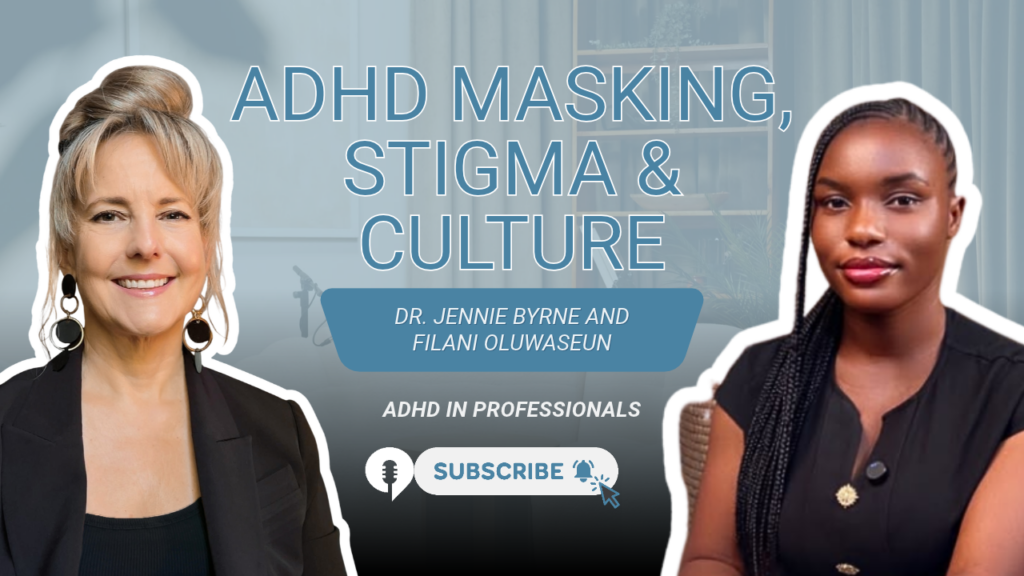
Dr. Jennie Byrne sat down with Filani for a LinkedIn Live connecting Africa and North America to talk about masking in adults with ADHD. One point became clear early: the pressures that push high-achieving adults to hide their ADHD look remarkably similar in Nigeria and in the US.
ADHD Masking at Work Exists Everywhere, and So Does the Stigma
Dr. Byrne opened with a framework she uses with her own patients. ADHD is a brain variant that is advantageous in some environments and less advantageous in others. It appears worldwide, possibly in up to 10% of the global population.
Filani sees that variant running into an environment that makes disclosure feel dangerous. Mental health awareness in Nigeria is low. Many adults recognize procrastination and executive function struggles in themselves, and they still avoid a diagnosis. They fear being labeled, losing their jobs, and being called lazy or useless by colleagues.
Founders feel this acutely. Filani has seen business owners receive their assessment results and refuse to own them. Their reasoning: how can someone who manages a large team have a problem with attention? To them, Filani said, the diagnosis “sounds too weird and difficult” to believe.
Dr. Byrne hears a nearly identical line from US physicians, lawyers, executives, and entrepreneurs: “You’re too high-functioning to have ADHD.” High achievement and ADHD coexist all the time. Stigma keeps people from seeing it in themselves.
Strong People Handle It Alone
Filani described a belief system that runs deep. Africans are expected to be strong and to manage their emotions without a third party, even through grief or depression. When Filani introduces therapy, people push back with questions like, “What is the difference between a therapist and my bestie at home?” They want to know how a clinician can be so sure about what is happening inside them.
Access makes it harder. People in Nigeria’s megacities can reach psychiatric hospitals and medication. People in rural areas have far fewer options, and mental health education often meets skepticism rooted in long-held cultural norms.
Dr. Byrne sees the same “be strong, never ask for help” message in many US families. Culture shapes whether someone ever reaches an assessment.
The Office That Rewards Looking Busy
Back to the man pacing the office. When Filani met with him afterward, a pattern emerged. His workplace rewarded multitasking and constant visible activity, and it treated anything that looked like distraction as unproductive. So he used his restlessness as cover, and fidgeting and motion became his proof of effort.
Dr. Byrne sees a version of this in professionals with ADHD all the time. Internal restlessness drives them to bounce from an email to a text to an instant message and back again. To a manager walking past, that person looks busy. In practice, a task can take ten times longer than it should, and the work spills into late nights and weekends.
“It’s really a recipe for burnout, depression, anxiety,” Dr. Byrne said. The organization rewards the visible activity and misses the exhaustion underneath it.
Filani has seen the same result. Masking leads to high levels of anxiety, burnout, and stress, and the fear of being dismissed from work the next day keeps people locked in it.
ADHD Masking Gets Passed Down
One of Filani’s sharpest points is that masking copies itself. Someone who has masked undiagnosed ADHD for 15 or 20 years tends to pass the same advice to the next person who confides in them: cover your flaws, find your way around it, and you’ll be fine over time. That advice steers people away from therapy entirely.
The cycle reaches into families too. ADHD can be hereditary, and Filani posed a question every parent with ADHD traits should sit with: what if your child has the same brain and can’t mask as well as you have?
Dr. Byrne built on this. Children watch how their parents handle their own brains. A parent who comes home exhausted, irritable, and absent after a day of masking teaches one lesson. A parent who says, “I have an ADHD kind of brain, and this is what works for me,” teaches a far more useful one. Kids pick up on shame, and they pick up on self-understanding just as readily.
Where ADHD Masking Falls Apart: Home
Filani pointed out that ADHD shapes far more than productivity. It affects how people function as spouses, partners, sons and daughters, and friends. “It shows in little moments,” Filani said: remembering dates, how someone speaks to people, how they respond to a loved one’s gestures.
Dr. Byrne sees this pattern clearly in high-achieving patients. They pour their mental energy into masking at work so they look productive, and home is where things fall apart. A thriving career can sit right alongside struggling relationships.
Self-Awareness First
Dr. Byrne asked what Filani would say to a successful professional who sees no reason to seek help. Filani’s answer centered on self-awareness. Self-knowledge matters beyond accolades and results. It lets a person build strategies that make life easier for themselves and for everyone around them. Filani asked why anyone would keep losing sleep, sliding into depression, and burning out when easier ways exist.
Dr. Byrne agreed. Understanding ADHD starts with understanding how a person’s brain and body connect, and what allows them to thrive. Medication can help, and therapy can help. Everyone is different, and everyone benefits from understanding themselves better.
Filani’s Takeaway for Employers and Employees
Filani closed with a message for both sides of the workplace. Masking grows out of environments that condition people to hide. Employers can take responsibility for learning about neurodiversity and how different brains work, and for educating their teams. Employees can commit to learning about themselves and about the people they work alongside.
For Dr. Byrne, the conversation was a strong reminder of how deeply culture intersects with mental health, and how much the environment people live and work in shapes what they believe about their own brains.
Ready to Understand How Your Brain Works?
If masking sounds familiar, an ADHD assessment can be a clear first step. Constellation PLLC offers ADHD assessments and care in 27 states, and coaching is available anywhere. Request a consultation through the contact form at constellationpllc.com/request-a-consultation.
For a deeper look at how ADHD affects physicians, executives, entrepreneurs, and other professionals, read Dr. Byrne’s book, ADHD in Professionals: Embracing Your Brain, on Amazon: https://www.amazon.com/ADHD-Professionals-Embracing-Your-Brain/dp/B0GZVBDQQH/
Resources
- BrainFirst Nigeria: https://brainfirst-site.vercel.app/
- Connect with Filani Oluwaseun on LinkedIn: https://www.linkedin.com/in/filani-oluwaseun-75115a18a/
- “A Western Thing: ADHD Stigma and the Nigerian Workplace” by Filani Oluwaseun: https://neurodiversity.org/a-western-thing-adhd-stigma-and-the-nigerian-workplace/
- Request an ADHD consultation with Constellation PLLC: http://constellationpllc.com/request-a-consultation
- ADHD in Professionals: Embracing Your Brain: https://www.amazon.com/ADHD-Professionals-Embracing-Your-Brain/dp/B0GZVBDQQH/