
There’s a moment that a lot of women in their 40s and 50s describe when they finally sit down with a clinician who understands both ADHD and perimenopause. It usually sounds something like this: “I’ve been told I’m anxious my whole life. I’ve tried every antidepressant. They helped a little, but nothing ever really made a dent. And now I’m hitting perimenopause and I’m just not handling it. My brain isn’t working. Something is wrong.”
That sentence — something is wrong — is both accurate and incomplete. Something is happening. Several things, often simultaneously. And untangling them requires someone willing to look at the whole picture at once.
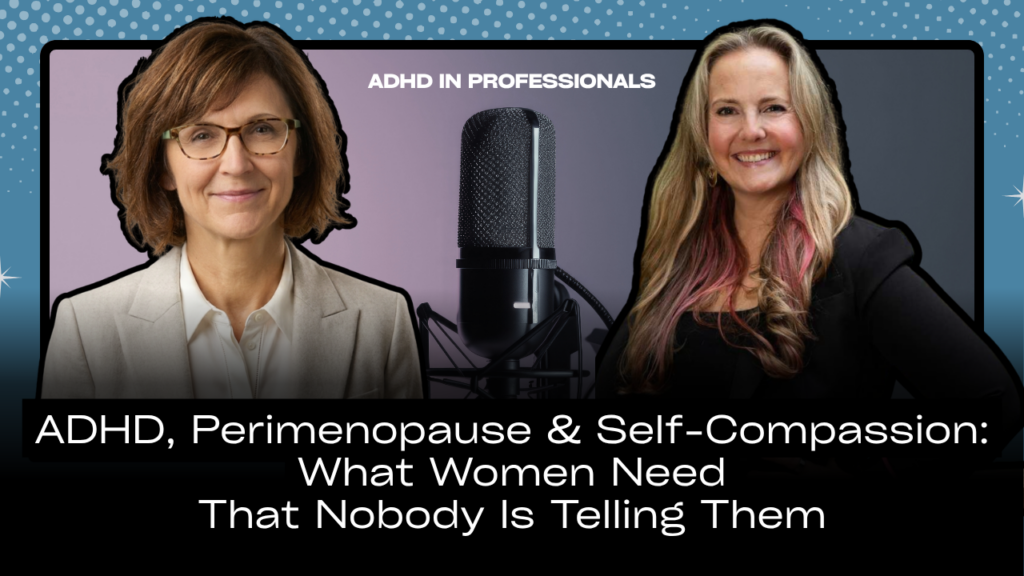
I sat down with Dr. Lidia Zylowska — psychiatrist, professor at the University of Minnesota Medical School, director of the adult ADHD program there, and one of the leading researchers and clinicians on mindfulness and self-compassion for ADHD — to talk about what that picture actually looks like, and what women in this phase of life genuinely need.
The triple convergence nobody warns ADHD perimenopause women about.
Women arriving at perimenopause with undiagnosed or undertreated ADHD are often navigating three significant pressures simultaneously — and none of them is small.
The first is hormonal. Estrogen has direct effects on cognition, focus, and emotional regulation. When it begins fluctuating during perimenopause — a transition that can span a decade — the coping strategies that carried someone through their thirties and forties stop working. The scaffolding comes down. What was manageable becomes genuinely hard.
The second is generational. Women in their 40s and 50s are often sandwiched — still parenting children who aren’t quite independent yet, while simultaneously watching their own parents begin to need care. The mental load of managing two generations, on top of a demanding professional life, is enormous by any measure.
The third is professional. This is the ironic one: many of the women I work with are, by external measures, at the peak of their careers. More senior, more respected, more credentialed than they’ve ever been. And they’re trying to perform at that level while their brain is running on depleted estrogen, accumulated burnout, and a nervous system that was never properly supported to begin with.
All three hit at once. And the cultural expectation — that a woman of this age should be managing all of it gracefully — is still very much intact.
The accumulated burnout nobody accounts for.
Lidia named something that I want clinicians and the professionals they treat to hear directly: by the time these women arrive in a clinical setting, there is almost always accumulated burnout that predates the perimenopause.
Perfectionism is often the coping mechanism. High-achieving women with ADHD learned early that doing more, preparing more, checking more times — being the person who never drops a ball — was the strategy that kept the gaps invisible. That strategy is exhausting to sustain for decades. And it produces a particular kind of burnout that isn’t just tiredness. It’s the collapse of a system that was running at unsustainable cost the whole time.
By the time perimenopause adds its layer, they’ve never really recovered from the years before it. And the cultural messages around them — from Instagram, from their communities, from well-meaning family members who notice that something has changed — are not helping them let go. They’re reinforcing the perfectionism.
The clinical goal, as Lidia put it, is to help women use this moment as an opportunity to reevaluate. Not to add more. To subtract. To ask what they actually need, what they can let go of, and what support they should be asking for rather than silently absorbing.
On the dinner question — and what it’s really about.
The dinner question comes up constantly in my practice. The woman who is spending two hours cooking every night, exhausted, executive function depleted, and cannot explain why she keeps doing it. When I ask “who says you have to cook dinner?” the response is almost always some version of: everyone. The culture. The other moms. My family. Myself.
Lidia’s observation is precise: the people who are kind and supportive to these women in most areas of their lives are often not kind and supportive about this particular permission. A partner noticing that dinner has changed. A family member asking if everything is okay because the house looks different. Well-meaning, not malicious. But reinforcing.
The internal struggle is where most of the work actually lives. It’s not about the dinner. It’s about decades of internalized expectation that a woman’s worth is partly measured by what she produces at home — and how hard it is to revise that equation even when you can see it clearly.
Self-compassion is the clinical intervention here. Not just as a soft recommendation, but as a genuine neurological tool.
What mindfulness and self-compassion actually do for an ADHD brain.
Lidia’s work on mindfulness for ADHD is among the most grounded in the field — she developed one of the first evidence-based mindfulness programs specifically for adults with ADHD, and she’s clear that this is not about adding a meditation practice to an already overwhelmed life.
Her framework for what she calls mindful self-coaching has three steps, each of which is designed to be brief and practical rather than daunting.
The first is checking in. Not once a day in a formal practice, but throughout the day — a brief, intentional moment of curiosity about your own internal state. Phone reminders can help, because the ADHD brain won’t self-generate this reliably. The question isn’t “am I okay” but “what am I actually noticing right now?” Clenched jaw. Shallow breathing. A sense that everything feels urgent. Just noticing, with curiosity rather than judgment.
The second is meeting yourself with compassion rather than criticism. Lidia draws on Kristin Neff’s self-compassion framework here: treat yourself as you would treat a friend in the same situation. The goal is not to fix the feeling but to acknowledge it. This is hard. I have a lot on my plate. This is a difficult moment. That acknowledgment — what Lidia calls witnessing — reduces the sense of isolation and begins to lower the emotional intensity.
The third is what becomes possible after the first two: cognitive flexibility. Once the emotional intensity comes down — even slightly — the prefrontal cortex re-engages. Problem-solving becomes available again. The meal that felt impossible to skip can be reconsidered. The phone call that felt impossible to make gets made. The permission that felt impossible to grant yourself is suddenly just: a choice.
This is the neuroscience of the shift. Moving from the emotional brain to the thinking brain isn’t about willpower. It’s about creating a brief pause that allows the shift to happen.
ADHD perimenopause women are deserving of their own attention.
Lidia’s single takeaway, when I pressed her: you are deserving of your own attention.
Not the critical internal attention that most ADHD brains are very good at — the voice that catalogs every gap, every failure, every thing that didn’t get done the way it should have. The curious, kind attention that might ask: how am I actually doing? What do I actually need? When did I last give myself anything?
That question is harder than it sounds. But the ripple effects, Lidia has found, are significant — in self-regulation, in cognitive flexibility, in how a person begins to relate to themselves and to the demands around them.
If any of this resonates — whether you’re a woman navigating this exact moment, a clinician trying to support women through it, or a partner trying to understand someone you love — there are resources worth knowing about.
Lidia’s mindfulness meditations and resources are available at lidiazylowska.com, including a YouTube channel with guided practices.
And if you’re wondering whether ADHD is part of your picture — or if what you’re experiencing right now deserves a proper clinical workup — Constellation PLLC offers comprehensive assessments across 26 states. Reach out via the contact form at constellationpllc.com.
Grab your copy of ADHD in Professionals: Embrace Your Brain here: https://www.amazon.com/ADHD-Professionals-Embracing-Your-Brain/dp/B0GZVBDQQH/
📌 Dr. Lidia Zylowska: lidiazylowska.com
📌 Lidia’s YouTube mindfulness meditations: https://www.youtube.com/@MindfulRxADHD/videos
📌 Constellation PLLC: constellationpllc.com
If you’re a woman in this season of life — what’s the one thing you’ve given yourself permission to stop doing? Drop it in the comments.