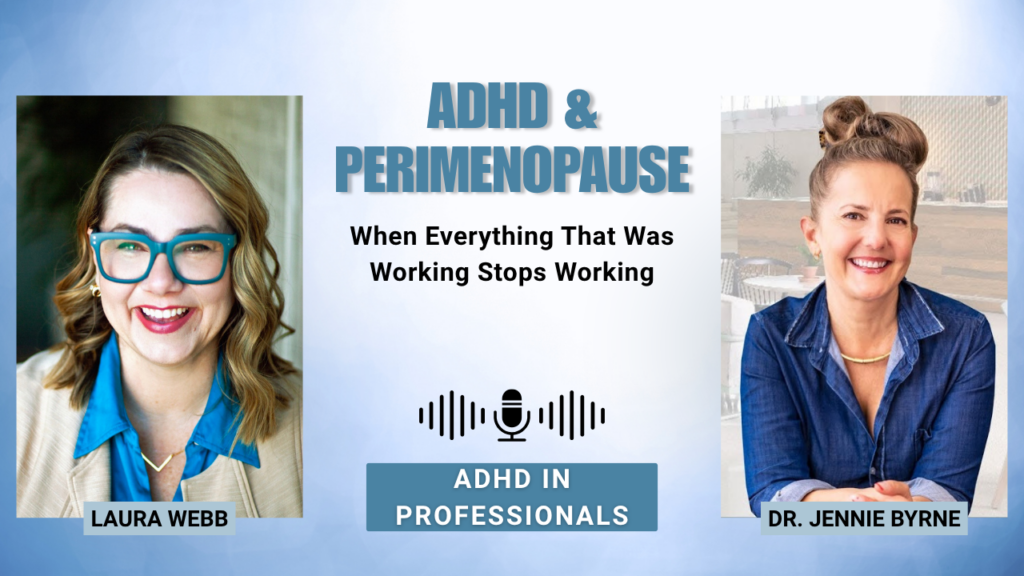
The phrase Laura Webb hears most often from women who have ADHD and perimenopause isn’t about brain fog or memory or focus. It’s simpler than that, and more disorienting: “I just don’t feel like myself.”
Laura is an educational therapist with 20 years of experience working with neurodivergent populations — dyslexia and ADHD specialization — and a later-in-life ADHD diagnosis herself. She figured out she had ADHD the same way a lot of women do: perimenopause stripped away the systems that had been holding everything together, and suddenly what was invisible became impossible to ignore.
She calls it “the call is coming from inside the house.” I sat down with her to talk about what’s actually happening when that call arrives, what it takes to answer it, and why the accommodation conversation for women in this stage of life almost never gets had.
Three presentations of ADHD and perimenopause — and how to tell them apart.
When perimenopausal women come to me wondering whether they have ADHD, they almost always fall into one of three categories.
The first: it’s not ADHD, but it looks like it. Estrogen decline has real neurological effects — on dopamine signaling, on working memory, on executive function, on emotional regulation. A woman who has never had ADHD can experience symptoms during perimenopause that are clinically indistinguishable from it. Getting the hormonal picture right comes first.
The second: it is ADHD, and perimenopause just uncovered it. This woman has been functioning for decades, often at a high level, using systems and structures and sheer willpower that worked until they didn’t. When estrogen dropped, the scaffolding came down. Now she can see what was always underneath it.
The third: it’s ADHD that was already known and managed — until perimenopause added enough neurological load that the existing management stopped being enough. The medication that worked at 38 needs to be revisited at 48. The coping strategies that carried her through her thirties need to be rebuilt for a different brain at a different hormonal baseline.
All three require different clinical responses. Which is why starting with a thorough assessment — one that looks at the medical picture, the hormonal picture, and the ADHD picture simultaneously — matters more at this life stage than at almost any other.
The honeymoon — and what comes after.
One of the patterns I see consistently once medication is dialed in: a honeymoon period. Things feel dramatically better. The brain fog lifts. The focus returns. The woman who had been drowning feels like she’s finally swimming.
And then, a few months later, sometimes six months later, sometimes a year later, she comes back. The medication is still working. And she’s still crying at night.
Still overwhelmed. Still feeling like the household is never done. Still feeling like she can’t be her best at work and at home simultaneously.
This is where the conversation usually needs to go deeper than medication. Because what’s happening isn’t a medication failure — it’s that the medication addressed the neurological piece while the environmental and cultural piece remained entirely intact. And that piece is significant.
The three-course meal nobody ordered.
Laura and I kept circling back to the same theme from different angles: the invisible labor that women with ADHD and perimenopause are carrying, which has nothing to do with their neurology and everything to do with cultural expectation.
The woman making three separate dinners every night because one child is vegan, one isn’t, and her spouse has preferences. The professional who is mentoring five colleagues because that’s what’s expected of women in her role, in a way it isn’t expected of the men at the same level. The perfectionism that keeps adding tasks — not because they need to happen, but because doing more feels safer than stopping.
Laura’s framing is useful: this isn’t people-pleasing in the pejorative sense. These women are deeply invested in the people they love. The work they’re doing is real and its motivations are genuine. The problem is that the ADHD brain, already operating at a high cost, cannot sustain that level of output across professional life, household management, and caregiving simultaneously — and the cultural pressure that makes all of it feel non-negotiable is often invisible to the person carrying it.
The accommodation, sometimes, is simply asking: who said you have to do this? What law requires three courses? What rule says the kids can’t handle the laundry? The question itself can be enough to surface assumptions that have been running on autopilot for years.
On disclosure — and the accommodations you can implement without asking anyone.
A live question during our conversation was practical and important: given ADA protections, what should professionals disclose to their employers, and what accommodations are reasonable?
My answer, and Laura’s, is that formal disclosure is always the individual’s choice. But many of the most effective accommodations don’t require disclosure at all.
Reducing sensory input — headphones, a quieter workspace, natural light over fluorescent — doesn’t require anyone to know why. Checking email at designated times rather than continuously is a boundary you can implement without explaining it. Blocking heads-down time for focused work, turning off Slack notifications during deep work windows, having a visual timer that signals do-not-disturb — all of these are things a professional can build into their environment without a formal accommodation request.
Laura uses a small visual timer that shows time passing without making noise. She wears headphones with soothing music at sensory-overwhelming environments like Costco. Small interventions. Significant impact. No diagnosis required.
The formal accommodation conversation becomes more relevant when performance is being directly affected — when deadlines are being missed, when the gap between what someone is capable of and what they’re producing is visible to others. At that point, the ADA does provide real protection, and having a clinical diagnosis and documentation matters.
Technology’s impact on women with ADHD and perimenopause.
This came up as something Laura is seeing more of in her practice: social media has become an additional source of misinformation and pressure specifically for perimenopausal women with ADHD. The perfectionism that drove decades of high achievement gets activated by curated images of women who seem to be doing all of it effortlessly. The attention that’s already harder to regulate gets further fragmented by platforms engineered to keep it.
The intervention is individual, but the experiment Laura recommends is consistent: put the device away. Not permanently — as an experiment. See what changes. For ADHD brains that struggle with consistent habit formation, framing screen limits as something to help the kids is often more motivating than framing it as something to help yourself. She’s seen families implement screen-free weeknights where the kids are stoked about Friday because it’s a genuine treat — a schedule that works partly because the mother needed it and partly because the structure helped everyone.
What community does that a self-led course cannot.
Laura founded the Squirrel Club — an affordable monthly subscription community for women navigating ADHD, perimenopause, and the intersection of both — because she recognized that the social media alternatives were mostly trying to sell things and making women feel worse. Self-led six-week courses for ADHD brains, she points out, almost never get finished. The ADHD brain buys the course, gets the downloadable, and never opens it again. That’s not a character failure. It’s an operating system mismatch.
What works is gentle, consistent accountability with someone who understands the brain they’re working with. Not a lot of time — sometimes 20 or 45 minutes. But a real human relationship where someone can reflect back what’s happening and help the person figure out the next step.
My recommendation, always: find someone who specializes. Whatever the budget allows, whatever the format, find someone who actually understands ADHD and perimenopause rather than someone who is trying to apply generic productivity frameworks to a brain they don’t understand.
The difference is significant. And at this stage of life, with this much going on in your body and your brain simultaneously, you deserve support that actually fits.
📌 If you’re in this moment — wondering whether what’s happening is perimenopause, ADHD, both, or something else entirely — an assessment is where the picture gets clearer. Constellation PLLC offers comprehensive ADHD assessments across 25 states. Reach out via the contact form at constellationpllc.com.
📌 If you’re looking for community and coaching specifically around ADHD and perimenopause, learn more about Laura’s Squirrel Club here: http://instagram.com/joinsquirrelclub
📌 Grab your copy of ADHD in Professionals: Embrace Your Brain here: https://www.amazon.com/ADHD-Professionals-Embracing-Your-Brain/dp/B0GZVBDQQH/
📌 Laura Webb — Squirrel Club: http://instagram.com/joinsquirrelclub
If you’re a woman who recognized yourself in this conversation — what was the moment things stopped working the way they used to? Drop it in the comments.
Dr. Jennie Byrne, MD, PhD is a neuroscientist, psychiatrist, and author whose work explores human behavior, mental health, and ADHD in high-achieving adults. In her latest book, “ADHD in Professionals: Embracing Your Brain,” she offers an honest, empowering look at how ADHD shows up in physicians, executives, entrepreneurs, and other professionals—and how they can better understand and work with their brains.
A board-certified psychiatrist with an MD/PhD in neuroscience, Dr. Byrne has built her career at the intersection of clinical care, leadership, and innovation. She is known for her clear, pragmatic voice on topics including ADHD, burnout, stigma, and the future of mental health care.
Dr. Byrne is also a sought-after speaker and thought leader committed to helping professionals navigate mental health with insight, candor, and compassion. Learn more at www.constellationpllc.com.