There’s a particular kind of exhaustion that comes from spending your whole life almost keeping up.
You’re smart. You’re capable. You’ve built a career, navigated relationships, figured out how to make things work — mostly. But underneath all of it, there’s this quiet, persistent feeling that you’re working twice as hard as everyone else just to stay even. That you’re missing something everyone else seems to know. That the gap between who you are and who you could be is somehow your fault.
That feeling has a name. And for a lot of people, it doesn’t get one until their forties.
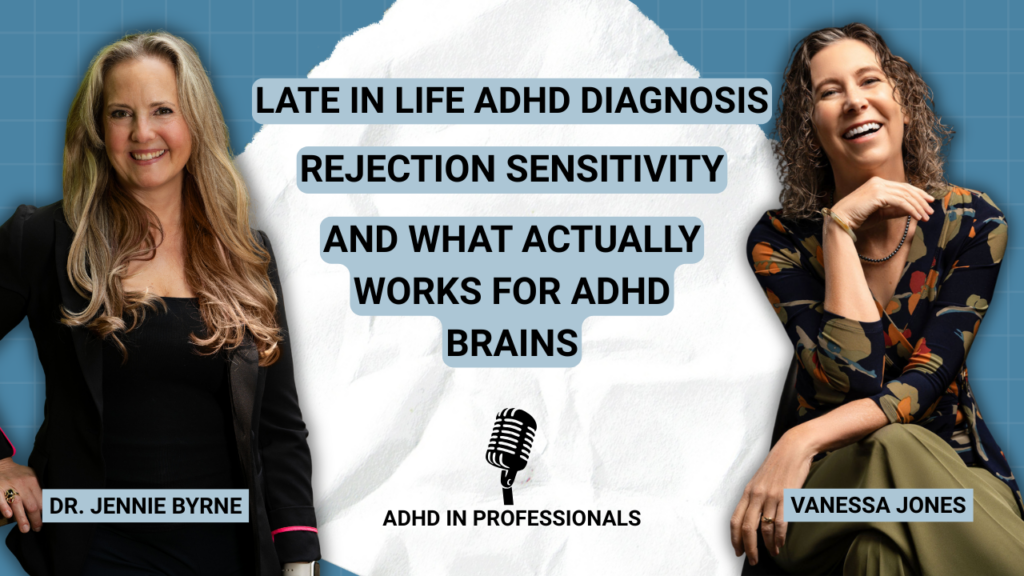
In this conversation, I sat down with Vanessa Jones — voice actor, entrepreneur, author, and one of my oldest friends — to talk about what it actually looks like to get an ADHD diagnosis as an adult. The grief of it. The relief of it. And what it takes to build a life that works with your brain instead of against it.
The diagnosis doesn’t end the confusion — it starts a whole other process.
Vanessa Jones was 42 when she finally connected the dots. She’d done a research project on ADHD in her twenties, taught students with ADHD, and still had no idea she was describing herself. It wasn’t until she heard a real person — not a clinical case study, but an actual human being — talk about his experience that something clicked.
She went and got tested. Got the diagnosis. And then spent years not quite believing it.
That’s more common than people realize. There’s often a honeymoon period right after diagnosis — finally, an explanation, a framework, a direction. And then the grief moves in. Because getting diagnosed as an adult means looking back over decades and asking hard questions about what might have been different. Relationships. Jobs. The moments where you felt judged, criticized, or simply invisible, and didn’t know why.
Rejection sensitivity is real — and it compounds.
One of the things Vanessa described so precisely was the accumulated weight of growing up not quite doing things the way everyone else seemed to do them. Sometimes people pointed it out. Often they didn’t. But she felt it either way.
That’s what rejection sensitive dysphoria looks like in practice. It’s not dramatic. It’s the third-grade teacher calling you in after class because your answer to “how do you cross the street” didn’t match what she expected — even though your answer was arguably more logical. It’s the workshop where everyone somehow knew to put their pictures on the wall, and you were sitting at the table happily reading magazine articles about walking after 50. It’s the meeting with your principal about a timeline you were never actually given.
Over a lifetime, that compounds into something heavy. Shame that accrues slowly, without you even tracking it. And then, when you finally get the diagnosis, you have to reckon with all of it.
The strategies that are supposed to help often don’t — because they weren’t built for your brain.
This is something I see constantly in my clinical work, and Vanessa named it clearly: professionals with ADHD are trained and advised by people who don’t understand their operating system. So they try to implement systems — Pomodoro timers, rigid time blocking, color-coded calendars — that were designed for neurotypical brains, and then feel like failures when those systems collapse.
Vanessa’s actual system looks different. She looks at her fixed commitments for the day — the meetings, the hard deadlines — and builds around them. When she has an open block of time, she doesn’t pre-assign it. She waits until she’s in it, checks in with how she’s feeling and what she has the capacity for, and chooses from her running list accordingly. Sometimes that’s an administrative task she’ll reward herself for completing. Sometimes it’s deep, focused writing. The point is that her interest-based nervous system gets a vote.
That’s not a lack of discipline. That’s an accurate read of how her brain actually functions.
She also shared something that stopped me: when she’s struggling to start something, she pretends she’s setting it up for someone she loves. Not for herself — for them. Because getting started is the hardest part, and sometimes love is a more accessible motivator than willpower. She lays out what that person would need to begin, and then she begins alongside them.
It’s a beautiful piece of self-knowledge, the kind that only comes from years of paying close attention to your own patterns.
Thriving with ADHD isn’t about fixing yourself. It’s about understanding your actual operating system.
Vanessa wrote her book — How Did That Happen? — to make sense of her own life through the lens of ADHD. She describes it as taking the scattershot of her experience and examining it more objectively, shifting from the amygdala’s emotional processing into something more frontal and cognitive. Structure as a way of creating distance from the pain of it, so she could finally look at it clearly.
That’s exactly what this work asks of people. Understanding the brain you actually have, rather than spending decades apologizing for the one you were told you should have.
If any of this conversation resonates — if you’ve been asking yourself whether it’s worth getting assessed, or whether what you’re experiencing has a name — my book ADHD in Professionals: Embrace Your Braingoes deep on exactly this.
Order your copy here: https://www.amazon.com/ADHD-Professionals-Embracing-Your-Brain/dp/B0GZVBDQQH/
Have questions about obtaining an ADHD diagnosis? Reach out by clicking here.
Dr. Jennie Byrne, MD, PhD is a neuroscientist, psychiatrist, and author whose work explores human behavior, mental health, and ADHD in high-achieving adults. In her latest book, “ADHD in Professionals: Embracing Your Brain,” she offers an honest, empowering look at how ADHD shows up in physicians, executives, entrepreneurs, and other professionals—and how they can better understand and work with their brains.
A board-certified psychiatrist with an MD/PhD in neuroscience, Dr. Byrne has built her career at the intersection of clinical care, leadership, and innovation. She is known for her clear, pragmatic voice on topics including ADHD, burnout, stigma, and the future of mental health care.
Dr. Byrne is also a sought-after speaker and thought leader committed to helping professionals navigate mental health with insight, candor, and compassion. Learn more at www.constellationpllc.com.