
There’s a particular cruelty in going to a doctor for help — knowing something is wrong, having the language for it, asking directly — and being sent home with the wrong answer.
It happens more than people realize. And it’s not always because the clinician is incompetent. Sometimes the reason why ADHD diagnoses get missed is because the medical system itself has built a culture that punishes doctors for taking ADHD seriously.
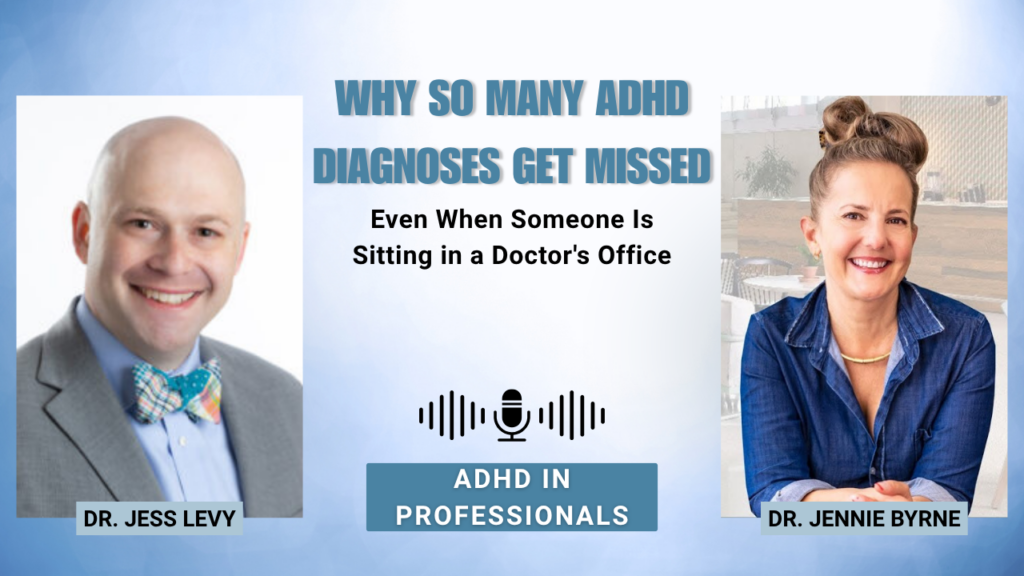
I sat down recently with Dr. Jess Levy, a psychiatrist in Cleveland, Ohio who is board-certified in both pediatric and adult psychiatry and runs A+ Psychiatry — the plus being very intentional, because ADHD rarely travels alone. We talked about the disability-versus-superpower debate, what actually happens when adults seek diagnosis, and why so many people come to a clinician already carrying a layer of medical trauma before they even walk in the door.
The “disorder” question is more complicated than either camp admits.
There’s a real tension in the ADHD world right now between the medical framing — ADHD as disorder, as disability, as something that requires treatment — and the strength-based framing that emphasizes what ADHD brains do well. Dr. Levy lands thoughtfully in the middle.
His view, and mine: the brain itself isn’t the problem. ADHD is a genuine brain variant — prevalent enough, and heritable enough, that it’s clearly part of the natural range of human cognition. The disorder piece comes from the mismatch between that brain and an environment designed for a very different operating system. Most professional environments are about as ADHD-unfriendly as it gets: long sustained attention tasks, rigid time structures, unwritten social expectations, endless administrative overhead.
The problem isn’t the brain. It’s the mismatch. But we can’t always fix the environment, so we have to figure out how to help people navigate it — and that’s where treatment comes in.
High-functioning doesn’t mean unaffected.
One of the things Dr. Levy said that I want people to really hear: if you’re a professional with ADHD, the comparison that matters isn’t to some general population standard. It’s to your peer group. The physician who gets through all her notes, but only by staying three hours after everyone else has gone home. The lawyer who delivers exceptional work, but at a cost no one else can see. On paper, success. Underneath it, a brain working twice as hard just to keep even.
That’s not high-functioning without impairment. That’s impairment wearing a very convincing mask.
And the gap between what people see and what’s actually happening is exactly why ADHD diagnoses get missed and why so many professionals come to me confused. They’ve been told they’re “too high-functioning” to have ADHD. They’ve been told their struggles are just anxiety, or depression, or a need to try harder. Sometimes they’ve gone through multiple rounds of neuropsychological testing and still walked away without a diagnosis.
That’s medical trauma. And it’s common.
The medical system has a cultural problem around ADHD — and it’s why ADHD diagnoses get missed.
Dr. Levy put it plainly: there’s a culture in medicine that rewards skepticism about ADHD diagnoses. Prescribing stimulants is treated as something to be suspicious of, as if every patient asking for help is trying to game the system. Clinicians worry about how it looks to their peers, about regulatory scrutiny, about being labeled a pill mill. And so they default to doubt — even when the evidence, and the patient in front of them, clearly points elsewhere.
The result is that patients who have done the hard work of seeking help get their experience invalidated by the very people who are supposed to understand it. They leave without a diagnosis, without treatment, and with a new layer of shame on top of everything they were already carrying.
Meanwhile — as Dr. Levy pointed out — if the same patient walked in describing episodes of elevated mood and impulsive decisions, the clinical instinct would be to act. The asymmetry is hard to justify.
Clinicians with lived ADHD experience ask different questions.
Dr. Levy has ADHD himself, and he talked about how that shapes the way he works. The questions he thinks to ask — how many thoughts are you holding at once right now, does your work bag look like an archeological dig — aren’t in the DSM. They come from knowing, from the inside, what the experience actually feels like.
That said, lived experience isn’t a requirement for good ADHD care. What matters is curiosity. Genuine interest in understanding the person in front of you, not fitting them into a diagnostic checklist. That curiosity is what leads a clinician to ask about the laundry basket instead of just the checklist. To notice what the patient doesn’t think to report because they’ve assumed their whole life that everyone functions this way.
If you’re still waiting for someone to take you seriously — that’s not a sign you don’t have ADHD.
Dr. Levy’s closing thought: there’s a different way of approaching the world that comes with an ADHD brain, and the goal isn’t to flatten it. It’s to understand it well enough that you can work with it instead of against it.
That’s the whole premise of my book, ADHD in Professionals: Embrace Your Brain — available on Amazon now. If you’ve spent years wondering whether something more is going on, or if you’ve already been dismissed by the medical system and need someone to actually listen, this book was written for exactly that moment.
Order your copy here: https://www.amazon.com/ADHD-Professionals-Embracing-Your-Brain/dp/B0GZVBDQQH/
What’s your experience been with getting an ADHD assessment or diagnosis? I’d love to hear in the comments.
Dr. Jennie Byrne, MD, PhD is a neuroscientist, psychiatrist, and author whose work explores human behavior, mental health, and ADHD in high-achieving adults. In her latest book, “ADHD in Professionals: Embracing Your Brain,” she offers an honest, empowering look at how ADHD shows up in physicians, executives, entrepreneurs, and other professionals—and how they can better understand and work with their brains.
A board-certified psychiatrist with an MD/PhD in neuroscience, Dr. Byrne has built her career at the intersection of clinical care, leadership, and innovation. She is known for her clear, pragmatic voice on topics including ADHD, burnout, stigma, and the future of mental health care.
Dr. Byrne is also a sought-after speaker and thought leader committed to helping professionals navigate mental health with insight, candor, and compassion. Learn more and request a consultation at www.constellationpllc.com/program.