
Most people who get an ADHD diagnosis spend the first year thinking about executive function. The focus, the time blindness, the task initiation, the inbox that hasn’t been touched in three weeks. That’s the vocabulary we’ve built around ADHD — and it’s not wrong, exactly. It’s just incomplete.
Because at least half of what makes ADHD hard in professional life has nothing to do with executive function. The impact of ADHD and emotional dysregulation is a major factor in the success of professionals with ADHD.
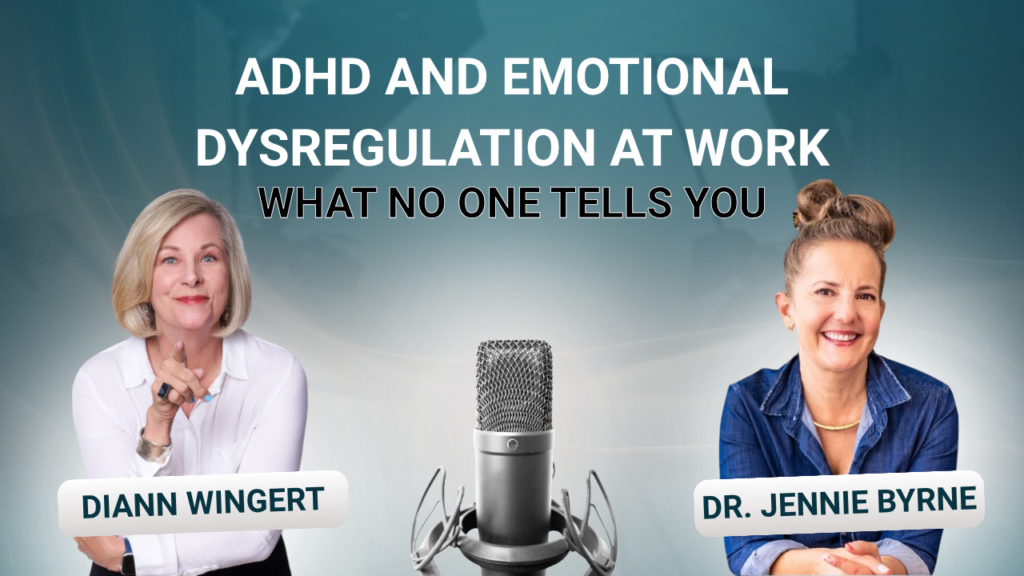
I had this conversation recently with Diann Wingert, a business strategist and coach who spent two decades as a psychotherapist before pivoting to work specifically with entrepreneurial professionals who have ADHD. She has ADHD herself, passed it to all three of her adult children before she even knew she had it, and has spent years watching people come to her asking for help with their productivity — only to discover that what’s actually driving the friction is something else entirely.
Why the emotional side gets ignored — and why that’s not an accident.
Part of it is a gender bias that’s baked into how we understand emotional expression. Women who are emotionally intense get labeled as dramatic, sensitive, too much. Men who are emotionally intense get labeled as passionate, driven, visionary. Same underlying dysregulation — wildly different cultural interpretation.
The result is that men with ADHD often come into coaching asking for systems and strategies. They want help with output. Diann’s job, frequently, is to slow that down and ask about what’s happening in their body and their relationships first. Most of the time, she says, they’re shocked to discover that’s even part of the conversation.
Women, by contrast, are often more aware that their emotions are a factor — but still carry enormous shame around it, especially in professional settings.
Neither group is actually dealing with it well. They’re just failing in different directions.
What ADHD and emotional dysregulation actually looks like in a professional.
From a clinical standpoint, the ADHD brain has a very reactive mood. Good news hits and you’re elated. A critical comment lands and suddenly everything is terrible — not because you’re being dramatic, but because your brain genuinely processes emotional inputs that intensely. ADHD brains can experience emotions up to 30% more intensely than neurotypical brains. That’s not a character flaw. That’s neurology.
And then — just as quickly — it passes. Which can be genuinely disorienting for everyone around you. The people in your orbit are still recalibrating from the explosion or the euphoria, their nervous systems slowly coming back to baseline, and you’ve already moved on and half-forgotten it happened.
Diann calls this the “itchy trigger finger.” ADHD brains are neurologically sensitive — to sights, sounds, the energy in a room, the tone behind someone’s words. That sensitivity is part of what makes people with ADHD perceptive and intuitive. It’s also what makes regulation hard when that sensitivity gets flooded.
The signals that something emotional is actually driving the problem.
Diann listens for specific things when she’s talking with a potential client. Recurring friction with team members, clients, or vendors — often framed as other people being the problem. A pattern of over-committing and then feeling taken advantage of. Difficulty with the “putting yourself out there” parts of running a business: selling, marketing, visibility. And especially: the constant sense of giving more than you’re getting, which arrives reliably with its own wave of dysregulation.
None of those are executive function problems. They’re emotional ones.
And on the medication side — something worth saying directly — the picture gets even more complicated. Some people are overmedicated in ways that actually blunt positive emotion along with the dysregulation. Some are taking stimulants timed for work performance, which means the medication wears off right as they walk through the front door at home — already exhausted from a full day of masking — and that’s when everything falls apart. The relationship, the family, the partner who thought they were getting the real you.
Medication is a tool. But the timing, dosage, and type of that tool matters enormously. And it works best alongside the kind of environmental and behavioral work that coaching can provide.
A framework for actually doing something about ADHD and Emotional Dysregulation.
Diann developed a framework she calls SPACE — an acronym that walks through the core moves of emotional regulation for an ADHD brain.
S is for Spot your patterns: build the self-awareness to recognize what consistently sets you off, and what your early warning signs look like physically, emotionally, and environmentally — the tension in your jaw, the sensory irritability, the difficulty finding words.
P is for Pause the escalation: specific tools to interrupt the momentum before it takes over. This is where targeted techniques live.
A is for Act in the moment: once you’ve paused, what do you actually do to regain a sense of control and prevent the situation from compounding?
C is for Clear the air: is there damage control needed with the people around you? ADHD brains rebound fast. The people around them often don’t.
E is for Evolve your system: this isn’t a one-time fix. Your ADHD isn’t going anywhere. The goal is a toolkit that grows with you.
The hardest part, Diann is clear about this, is not learning the steps. It’s remembering you know them when you’re already activated. The brain under stress defaults to whatever neural pathway it’s been running for decades. That’s why she recommends practicing the framework when you’re calm — so it has a chance of being accessible when you actually need it.
If you’re recognizing yourself in any of this.
You are not broken. You are not alone. There is a growing number of people discovering well into their thirties, forties, fifties, and beyond that they have always been this way — and that understanding it changes everything.
It’s never too late to figure this out.
My book ADHD in Professionals: Embrace Your Brain goes deep on exactly this territory — the emotional, the relational, the professional. Order your copy HERE.
📌 Connect with Diann Wingert HERE
📌 Listen to Diann’s podcast, ADHD-ish HERE
📌 Access Diann’s SPACE framework handout HERE
Dr. Jennie Byrne, MD, PhD is a neuroscientist, psychiatrist, and author whose work explores human behavior, mental health, and ADHD in high-achieving adults. In her latest book, “ADHD in Professionals: Embracing Your Brain,” she offers an honest, empowering look at how ADHD shows up in physicians, executives, entrepreneurs, and other professionals—and how they can better understand and work with their brains.
A board-certified psychiatrist with an MD/PhD in neuroscience, Dr. Byrne has built her career at the intersection of clinical care, leadership, and innovation. She is known for her clear, pragmatic voice on topics including ADHD, burnout, stigma, and the future of mental health care.
Dr. Byrne is also a sought-after speaker and thought leader committed to helping professionals navigate mental health with insight, candor, and compassion. Learn more at www.constellationpllc.com.