There’s a concept in urban design called the curb cut effect. Curb cuts — the sloped ramps built into sidewalk curbs — were originally mandated as an accommodation for wheelchair users. What nobody anticipated was who else would use them: parents with strollers, delivery workers with hand trucks, cyclists, elderly people with walkers, travelers with luggage. The accommodation built for one group improved daily life for almost everyone.
The same thing happens, consistently, when organizations make changes to support neurodivergent employees.
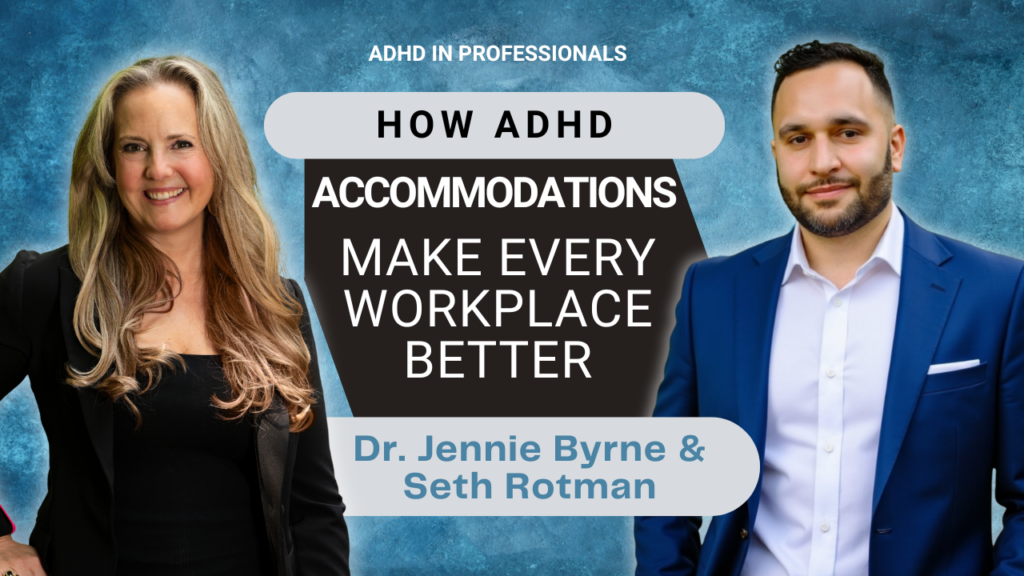
I sat down with Seth Rotman — board-certified nurse coach, certified clinical ADHD specialist, and author of There Is No Box: Going From Failing to Thriving with ADHD — to talk about what that looks like in practice. Seth works with high-performing professionals and organizations, bringing both 15 years of clinical background and 40 years of lived ADHD experience to the work. The conversation covered everything from a grant writer whose unmanaged ADHD nearly cost her company millions, to why tone-checking software might be the most underused workplace tool most organizations already have.
ADHD follows you everywhere. That’s the starting point.
Seth’s favorite quote is from Buckaroo Banzai: “Wherever you go, there you are.” He uses it to make a point that most organizational ADHD programs miss: there is no leaving it at the door.
Whatever is happening at home is amplified at work. Whatever is happening at work follows someone home. The anxiety that builds through a day of misread Slack messages and missed context cues doesn’t dissolve at five o’clock — it walks in the front door alongside the person carrying it. And the decision fatigue of navigating a workplace that wasn’t designed for your brain (or doesn’t make ADHD accommodations) compounds everything else that waits on the other side.
This is why Seth’s organizational work always includes the home environment, even when he’s been brought in to address a workplace performance issue. The two aren’t separable. Treating them as separate is one of the reasons so many workplace ADHD interventions produce limited results.
The grant writer and the one-hour delivery window.
Seth was brought into a renewable energy company to work with a team leader who was brilliant at her job — responsible for writing grants and leading the grant-writing process — but whose ADHD was creating enough inconsistency that the organization was at risk of losing her. Any missed deadline could mean hundreds of thousands of dollars in lost funding.
The workplace issues were real: rejection sensitive dysphoria turning routine Slack messages into perceived attacks, missed deadlines, difficulty leading her team. The root of all of it, once Seth got into it, was home.
She lived 45 minutes from an Amazon fulfillment center with one-hour delivery. The impulse purchasing was constant — multiple times a day — driven by the dopamine-seeking that unmanaged ADHD generates. Boxes she hadn’t opened in years lined the walls. The house had pathways to navigate through the clutter. She hadn’t cooked a meal or had people over. The overwhelm of the home environment was following her to work every single day.
In eight weeks: the kitchen was cleaned and had a system to keep it that way. A yard sale cleared an enormous amount. The impulse purchasing stopped. And with that foundation — for the first time in years — she felt confident having people over and was cooking for her family again.
That confidence carried back into the workplace. The email and Slack responses improved. She started leading her team again. Ten weeks from their first session, she had saved enough from the stopped impulse purchasing to put a down payment on the house she and her husband had been hoping to buy.
This is the impact of unmanaged ADHD.
The tool that was already there.
One of the most useful things Seth uncovered in that same engagement: the organization had a communication tool — similar to Grammarly — that they were using exclusively for spelling and grammar checking. The tool had a tone-checking feature that nobody was using.
For someone with rejection sensitive dysphoria, a terse Slack message — sent in two seconds by someone thinking they were being efficient — can register as an attack. The nervous system responds accordingly. Work stops. The spiral begins. By the time the misunderstanding gets untangled, hours have been lost and the emotional residue lingers.
The tone-checking feature changed this. Not only could she check the tone of her outgoing messages before sending — catching moments when her own communication was coming across more sharply than intended — she could check the tone of messages she received. Suddenly the aggressive-sounding Slack message from a colleague read as neutral. The whole dynamic shifted.
This is the curb cut effect in action. A feature that might have been unlocked because one person had rejection sensitive dysphoria ended up improving communication across the entire team.
I had to share my own version of this. At a previous job, my manager had a habit of sending messages that read as urgent and alarming — “I need to talk to you today” — without context, and then being unavailable for hours. I don’t have ADHD, but my sympathetic nervous system responded every time. The anxiety while waiting was genuinely distressing. When the conversation finally happened, it was invariably about something completely inconsequential. A tone-checking culture would have helped everyone in that organization.
Captions, transcriptions, and what millennials already know.
Seth made a point about meeting captions that I want to highlight specifically, because it reframes the accommodation entirely.
When ADHD co-occurs with auditory processing difficulties — which is common — a verbal meeting without written support means significant cognitive overhead just to track what’s being said, let alone participate meaningfully. Adding captions to a Zoom or Teams call takes one click. And as Seth pointed out: an entire generation of people already watch television with captions on by default. This is how an ADHD accommodation built for one need has become a preference for millions.
The same applies to transcription. I’ve started transcribing most of my meetings — with permission — and found that it makes me more relaxed as the person running them. I can be present in the conversation instead of managing the anxiety of trying to capture everything at once. If something was said and there’s a question later, we can check. It creates a kind of accountability and clarity that benefits everyone at the table.
Two words to consider removing from your vocabulary as a leader.
Seth mentioned something in passing that I want to point out: the words “just” and “should.”
“Just get it done.” or “You should be able to handle this.”
These phrases close the conversation. They carry an embedded judgment — that the task is simple, that the person’s difficulty with it reflects a deficiency rather than a legitimate barrier. For someone with ADHD who has already received tens of thousands of negative messages over the course of a lifetime, those words don’t land neutrally. They activate shame and reinforce the narrative that something is fundamentally wrong with them.
Removing them from your leadership vocabulary costs nothing. Replacing them with language that identifies the barrier — “What’s getting in the way here?” “What would make this easier?” — opens the conversation instead of closing it. And it helps neurodivergent and neurotypical employees equally.
The adapt-or-lose-people reality.
Seth put it plainly: “It’s Darwinism.” Workplaces that refuse to adapt — that default to “this is how we’ve always done it” as a reason rather than an excuse — will lose people. They’ll lose institutional knowledge. They’ll lose the grant writer who almost took millions in potential funding with her when she left.
The good news is that most of the changes that make workplaces more functional for neurodivergent employees are low-cost, already available, and immediately beneficial to everyone else. Tone-checking tools. Meeting transcriptions. Written agendas before calls. Follow-up summaries after them. Captions on virtual meetings. Asking people directly how they communicate best.
These aren’t accommodations that require a disclosed diagnosis to implement. They’re just better ways of running an organization.
And when the team’s anxiety comes down — when the sympathetic nervous system isn’t running at a constant elevated baseline — everyone performs better. Including the leader.
If you’re a professional whose ADHD has been the invisible variable in your workplace struggles, an assessment is where understanding starts. Constellation PLLC serves patients across 25 states. Reach out via the contact form at constellationpllc.com.
And grab your copy of ADHD in Professionals: Embrace Your Brain here: https://www.amazon.com/ADHD-Professionals-Embracing-Your-Brain/dp/B0GZVBDQQH/
📌 Seth Rotman — Clarify Wellness: clarifywellness.coach
📌 There Is No Box by Seth Rotman: https://www.amazon.ca/There-No-Box-Failing-Thriving-ebook/dp/B0HCF1Q3XC
📌 Request an ADHD Consultation: constellationpllc.com/request-a-consultation
Dr. Jennie Byrne, MD, PhD is a neuroscientist, psychiatrist, and author whose work explores human behavior, mental health, and ADHD in high-achieving adults. In her latest book, “ADHD in Professionals: Embracing Your Brain,” she offers an honest, empowering look at how ADHD shows up in physicians, executives, entrepreneurs, and other professionals—and how they can better understand and work with their brains.
A board-certified psychiatrist with an MD/PhD in neuroscience, Dr. Byrne has built her career at the intersection of clinical care, leadership, and innovation. She is known for her clear, pragmatic voice on topics including ADHD, burnout, stigma, and the future of mental health care.
Dr. Byrne is also a sought-after speaker and thought leader committed to helping professionals navigate mental health with insight, candor, and compassion. Learn more at www.constellationpllc.com.