By the time a child with ADHD reaches third grade, they’ve received approximately 20,000 negative comments directed at their behavior — just in school. Not at home. Not from peers. Just in the classroom.
By the time that child is an adult, those comments have become an internal voice. The one that says “I’m lazy” when a task doesn’t get done, “I’m irresponsible” when something gets forgotten, “I’m not cut out for this” when the wheels come off somewhere unexpected.
That voice is wrong. And understanding why it’s wrong is the foundation of everything else.
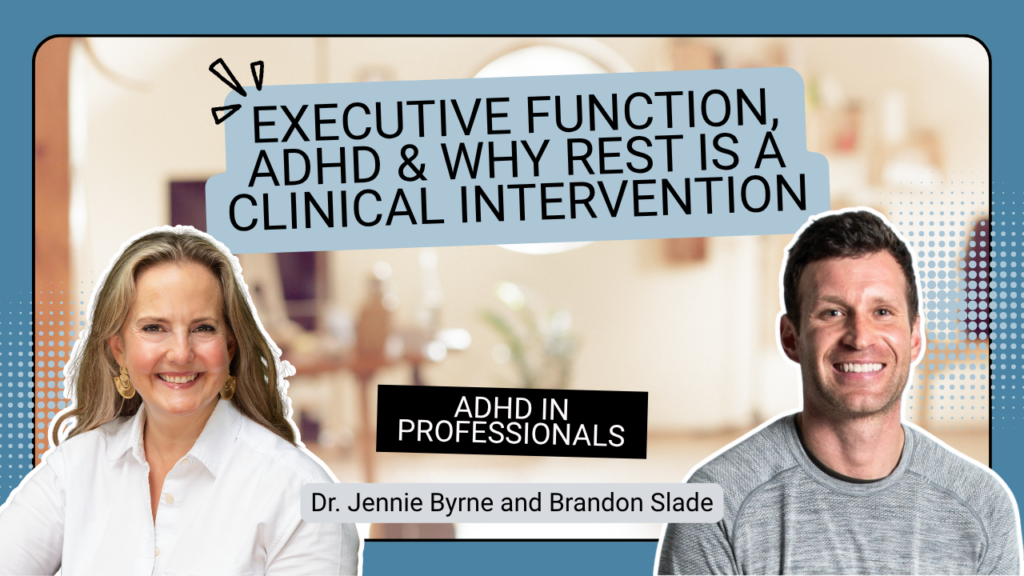
I sat down with Brandon Slade — school psychologist, founder of Untapped Learning, and someone diagnosed with hyperactive ADHD at age six — to talk about executive function and ADHD, the interest-based nervous system, why rest is a clinical intervention, and how relationship itself is a delivery mechanism for strategy. Brandon’s connection dropped before we reached his closing thoughts, but his core message came through clearly: executive function challenges are skills to be developed, not character flaws to be overcome.
Executive function and ADHD.
Brandon’s 10,000-foot definition: the complex set of skills that work together to help you achieve your goals. Not just big goals — any goal, from finishing a complicated work project to remembering to bring a coat in from recess. Executive function is what breaks down a large objective into steps, keeps the goal active in working memory, stays flexible when things don’t go as planned, and regulates the emotional responses that arise when they don’t.
My clinical lens adds some biological specificity to that: attention to stimuli, working memory, emotional regulation, task initiation, cognitive flexibility. These aren’t personality traits. They’re neurological processes — and they look different in an ADHD brain than in a neurotypical one, not because the brain is broken, but because it’s operating on a different system.
This matters because of what it changes. When a student forgets to turn in an assignment, the most available interpretation — from teachers, parents, sometimes the student themselves — is that they’re lazy, or careless, or not trying. Brandon’s framing is precise: forgetting to turn in an assignment doesn’t make you lazy, the same way lying down doesn’t make you rude. It means there’s skill development work to be done. That’s a fundamentally different conversation, and it’s one that most of the people I work with never got to have — not as kids, and not as adults.
The interest-based nervous system — and why the school system was never designed for it.
Brandon introduced Dr. William Dodson’s framework, and it’s one I find consistently useful clinically. The neurotypical brain is motivated by importance, rewards, and consequences. Secondhand importance — “this is worth a significant portion of your grade” — moves most students, but it doesn’t move ADHD brains.
ADHD brains are motivated by interest, passion, novelty, and urgency. Not because of a lack of discipline, but because of how the dopamine system operates differently — secondhand importance doesn’t generate the activation the brain needs to engage.
Brandon made a structural observation that reframes the entire conversation: school requires students to be generalists — competent across seven or eight subjects simultaneously. College narrows it to three or four. The real world, for most people, rewards becoming extraordinary at one thing. ADHD brains are built for that last stage. The first two stages are where the friction lives, and where most of the damage to self-concept happens.
The intervention isn’t to force the ADHD brain into the generalist mold indefinitely. It’s to support someone through the generalist phase well enough that they can eventually build a life and career around their area of genuine interest — where the hyperfocus that frustrated every teacher becomes the thing that makes them exceptional.
I saw this with my own kid in high school. Once we stopped fighting the generalist structure and found a dual enrollment path in an area of genuine interest, everything shifted. The interest-based nervous system finally had something to work with.
Perfectionism, exhaustion, and the women who are trying to be generalists in every domain of their lives.
This came up naturally in our conversation, and it’s something I see constantly in my practice: high-achieving women who have built successful, specialized professional careers, and who are simultaneously being asked by culture to perform excellence across every other domain as well.
Their job has allowed them to specialize. Their life has not. They’re trying to be extraordinary at work, at home, as a partner, as a parent, as a household manager — and the executive function load of maintaining all of that is crushing. Not because they’re weak, but because nobody’s ADHD brain was built for that level of sustained generalism across all domains simultaneously.
Brandon’s practice has seen an explosion in what he calls perfectionist anxiety — and his clinical observation is precise: perfectionism actively degrades executive function. You can’t sustain peak attention indefinitely, and trying to forces the brain into a state of chronic activation that produces burnout without producing the results the perfectionism was chasing.
Rest is not a reward. It’s a clinical intervention.
This is one of the most undervalued insights in the executive function and ADHD conversation, and Brandon framed it clearly.
On a 1-to-10 attention scale — where 1 is essentially asleep and 10 is the most focused you’ve ever been — the goal is to reach and sustain a 7 or 8 during focused work, and then return to a 2 or 3 during breaks. Not a 5. Not scrolling, which keeps the nervous system at a low-grade anxious activation without actually recovering. A genuine 2 or 3: a walk where your attention drifts naturally, looking at something without analyzing it, doing something with your hands, letting the brain fully disengage.
What we know from sleep research applies here too: the brain’s memory consolidation and recovery happen during specific types of rest. Disrupting those — by never fully deactivating, by treating rest as something to be earned rather than structured into the day — accumulates a cognitive debt that medication and strategy can’t fully offset.
Brandon made an analogy that resonates with a specific subset of my patients: athletes understand this intuitively. You don’t build muscle by lifting every day without recovery. You build it through load and recovery, load and recovery. The brain is the same. The people who trained their bodies to perform at a high level often respond well to this framing, because they’ve already internalized rest as part of performance.
Relationship as the delivery mechanism for strategy.
Before the connection dropped, Brandon introduced the insight I most wanted to explore: relationship is not just the context for strategy. It’s the mechanism through which strategy actually works.
For children with ADHD — who have been on the receiving end of thousands of corrections, criticisms, and directives — being told what to do by another authority figure is already loaded. The executive function skills that Brandon builds with students are genuinely hard. They’re uncomfortable. They require sustained effort in exactly the areas that are neurologically most difficult. Without trust, without a real relationship, without the sense that someone is walking the path alongside them rather than standing at the end of it telling them to hurry up — the strategy doesn’t land.
The same is true for adults. This is why I think coaching, done well, works differently from instruction. And it’s why assessment is only the beginning — the relationship built in treatment is what actually moves the needle.
Brandon’s suggestion for how to open that conversation, whether you’re a parent, spouse, colleague, or friend: start with a walk. Side-by-side movement, without the face-to-face pressure of a direct conversation, lowers the activation enough that real things can be said. It’s a simple recommendation. It works.
Brandon’s final thoughts (added after the session — from Brandon Slade, Untapped Learning): “The most important thing I want people to take away is that executive function and ADHD challenges are not who you are. They’re skills — and skills can be developed. Understanding that you have a different nervous system isn’t a limitation. It’s the beginning of building a life that actually works for your brain.”
If you’d like to connect with Brandon and the work Untapped Learning is doing with students, professionals, and organizations across the country, you can reach him at untappedlearning.org.
If you’re a professional looking for an ADHD assessment, Constellation PLLC serves patients across 25 states. Reach out for an ADHD screening and support at constellationpllc.com.
And grab your copy of ADHD in Professionals: Embrace Your Brain here: https://www.amazon.com/ADHD-Professionals-Embracing-Your-Brain/dp/B0GZVBDQQH/
📌 Untapped Learning — Brandon Slade: untappedlearning.org
📌 Constellation PLLC: constellationpllc.com
📌 Free ADHD resource list: constellationpllc.com/adhd-resources
What’s the internal voice you’ve been carrying the longest — the one that sounds like a character flaw but might actually be an executive function skill still in development? Drop it in the comments.
Dr. Jennie Byrne, MD, PhD is a neuroscientist, psychiatrist, and author whose work explores human behavior, mental health, and ADHD in high-achieving adults. In her latest book, “ADHD in Professionals: Embracing Your Brain,” she offers an honest, empowering look at how ADHD shows up in physicians, executives, entrepreneurs, and other professionals—and how they can better understand and work with their brains.
A board-certified psychiatrist with an MD/PhD in neuroscience, Dr. Byrne has built her career at the intersection of clinical care, leadership, and innovation. She is known for her clear, pragmatic voice on topics including ADHD, burnout, stigma, and the future of mental health care.
Dr. Byrne is also a sought-after speaker and thought leader committed to helping professionals navigate mental health with insight, candor, and compassion. Learn more at www.constellationpllc.com.