Most conversations about burnout treat it as a workplace problem: too much output, with not enough recovery, on repeat until something breaks.
That framing is incomplete for anyone. But for neurodivergent people, it overlooks the bulk of what’s actually happening.
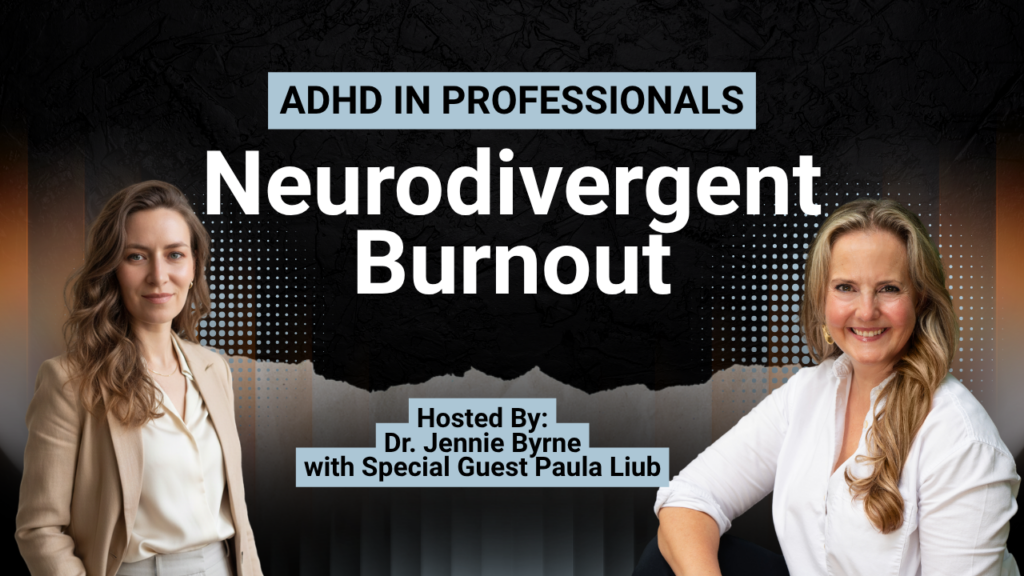
I sat down with Paula Liub — psychologist, autistic and ADHD herself, and a specialist in neurodivergent burnout for the past six years — to talk about what burnout actually is, why it’s so much more layered for neurodivergent people, and what recovery genuinely requires. Paula also trains psychologists, coaches, therapists, and counselors who work with neurodivergent clients, which gave this conversation a clinical depth that most burnout discussions don’t address.
What neurodivergent burnout actually is — and how it’s different from depression.
Paula works from the WHO definition — burnout as the result of sustained, long-term chronic stress — with one important modification: the WHO connects burnout exclusively to workplace stress, and that’s too narrow. Life stress, relational stress, systemic stress, the constant cognitive overhead of navigating a world that wasn’t built for your brain — all of these can produce burnout, and for neurodivergent people, they routinely do.
What distinguishes burnout clinically from depression or anxiety is that burnout is primarily neurophysiological. The brain — and often the body — is over-stressed. The systems are depleted. In theory, that means it can heal. But the healing requires something different from what treats depression or anxiety, which is why someone being treated for one thing while actually experiencing another is a pattern I see constantly in my practice.
The invisible drains that neurotypical burnout frameworks miss.
For neurotypical people, burnout is generally about workload. For neurodivergent people, the energy drain is happening on multiple channels simultaneously — many of them invisible to anyone observing from the outside, and sometimes invisible to the person themselves.
Paula listed some of them: sensory overwhelm and overstimulation. Cognitive and auditory processing delays — the extra energy it takes to process what someone is saying, figure out what they mean, and formulate a response in real time. Rejection sensitivity, which turns ambiguous social interactions into potential threats that require constant monitoring. Emotional dysregulation and nervous system dysregulation, which can produce shutdown or meltdown states that look disproportionate to what triggered them. Alexithymia — difficulty identifying or naming emotions — which means a person may be experiencing significant internal distress without being able to locate or describe it. Interoception difficulties, which create a similar gap between physical sensation and conscious awareness.
Each of these operates as a continuous background drain on cognitive and physiological resources. None of them show up on a performance review. And most workplace burnout frameworks don’t account for any of them.
Add to that the frequently undiagnosed or mismanaged chronic physical conditions that co-occur with neurodivergence at high rates — iron deficiency, dysautonomia, fibromyalgia, MCAS — and the picture becomes clear: treating neurodivergent burnout as a workload problem is like trying to fix a car with the wrong set of tools. You’re working on the wrong thing.
What neurodivergent burnout recovery actually requires.
Paula’s framework for recovery has two sides: reduce the demands, and increase the inputs. Simple in principle, genuinely difficult in practice — because for neurodivergent people, the demands extend far beyond the obvious ones.
Reducing demands means looking not just at workload but at sensory environment, social overhead, the cognitive cost of communication processing, and the physiological burden of any unaddressed medical issues. Increasing inputs means asking basic questions that often get skipped: are you getting enough food, enough sleep, enough movement? Are there any sources of genuine rest, pleasure, and joy in your daily life — not as productivity optimization, but as biological requirements for a nervous system that’s been running on reserve?
Neither of these is as simple as it sounds. That’s where individual support comes in — and why a single practitioner, however skilled, often can’t address the full picture alone.
On disclosure — and what you don’t have to say to ask for what you need.
One of the most practically useful things Paula said: you don’t have to disclose a diagnosis to ask for accommodations.
You can ask for meeting agendas to be sent in advance without explaining why ambiguous meeting invitations trigger anxiety spirals. You can ask for written summaries of verbal instructions without disclosing that you have auditory processing difficulties. You can ask for meetings to be recorded or transcribed without identifying yourself as neurodivergent.
These requests are reasonable. Many of them are standard practice in neurotypical settings for the same reason they’re essential in neurodivergent ones: they reduce misunderstanding, they create accountability, and they make communication more effective for everyone. A team that sends agendas before meetings and action items after them functions better regardless of who is on it.
The disclosure decision belongs entirely to the person. But the needs can be met before that decision is made.
The trauma question.
A live question came in during our conversation: is there evidence that trauma causes neurodivergence?
My position, based on clinical experience: I don’t see evidence that psychological trauma causes ADHD. ADHD reads to me as a brain type — highly genetic, present from the beginning, consistent across the lifespan. Trauma is a layer that can create significant neurophysiological changes, particularly when it occurs early in development, but it’s a separate layer from the neurology itself.
Paula added appropriate nuance: the research is still early, physical head trauma is a different question from psychological trauma, and the two often co-occur in ways that need to be understood and addressed together. What both of us agree on is that when trauma and neurodivergence are both present, they need to be worked with together — and that knowing which one to address first requires clinical judgment that a checklist can’t provide.
The misinformation problem in clinical settings.
One of the reasons I wrote ADHD in Professionals: Embrace Your Brain is something I keep watching happen: clinicians who are genuinely skilled at treating depression, anxiety, and other conditions spreading misinformation about ADHD and neurodivergence — not out of malice, but out of incomplete training.
“You’re too successful to have ADHD.” “You’re too high-functioning to have autism.” These are things I’ve heard from respected colleagues. And every time one of those statements lands on a patient who came in looking for answers, it delays their care, compounds their shame, and sends them back into the cycle of assuming something is fundamentally wrong with them.
Paula made a point that crystallized something I’ve been observing for years: neurodivergent people in medical and mental health settings often have everything attributed to anxiety. Every symptom, every complaint, every difficulty gets filed under that label — not because it’s accurate, but because it’s available and familiar. The cost of that pattern is significant, and it falls entirely on the patient.
The multidisciplinary argument.
Neither Paula nor I can be everything a neurodivergent person in burnout needs. I bring the medical perspective — the full history, the lab work, the medication piece, the neurological context, the substance review, the physical health picture that becomes increasingly complex as people age into their forties, fifties, and sixties. Paula brings the psychological, environmental, and somatic picture — the burnout framework, the nervous system regulation work, the practical coaching around how a neurodivergent person navigates a world that wasn’t built for them.
The technology to work as a team — coordination calls, shared clinical frameworks, permission-based communication — exists and is accessible. What’s missing is the will to use it, and the training to know when to refer.
Paula’s advice to any practitioner working with neurodivergent clients: learn enough about the intersecting systems to know what you don’t know, and to refer accordingly. No single clinician can hold all of it. But a team can.
Paula’s closing line.
Neurodivergent burnout is not your fault. Recovery is in your hands.
That sentence does a lot of work. It removes the self-blame that neurodivergent people in burnout almost universally carry. And it preserves the agency — because recovery isn’t something that happens to you. It’s something you build, with the right support, one layer at a time.
If you’re a professional navigating burnout alongside ADHD or other neurodivergence — or wondering whether what you’re experiencing has either of those names — I’d love to help you figure out the medical and clinical picture.
Reach out via the contact form at constellationpllc.com. And if you’re a practitioner looking for training on neurodivergent burnout, Paula’s resources are at paula-mindfulness.com.
Grab your copy of ADHD in Professionals: Embrace Your Brain HERE.
📌 Paula Liub — Neurodivergent Burnout Specialist: paula-mindfulness.com
📌 Constellation PLLC: constellationpllc.com
📌 Free ADHD resource list: constellationpllc.com/adhd-resources
If you’re a neurodivergent professional who has experienced burnout — what was the invisible drain that nobody around you could see? Drop it in the comments.
Dr. Jennie Byrne, MD, PhD is a neuroscientist, psychiatrist, and author whose work explores human behavior, mental health, and ADHD in high-achieving adults. In her latest book, “ADHD in Professionals: Embracing Your Brain,” she offers an honest, empowering look at how ADHD shows up in physicians, executives, entrepreneurs, and other professionals—and how they can better understand and work with their brains.
A board-certified psychiatrist with an MD/PhD in neuroscience, Dr. Byrne has built her career at the intersection of clinical care, leadership, and innovation. She is known for her clear, pragmatic voice on topics including ADHD, burnout, stigma, and the future of mental health care.
Dr. Byrne is also a sought-after speaker and thought leader committed to helping professionals navigate mental health with insight, candor, and compassion. Learn more at www.constellationpllc.com.