Most relationship advice for people with ADHD says the same thing: get out there. Join something. Put yourself in social situations.
That advice isn’t wrong. It’s just not specific enough to be useful.
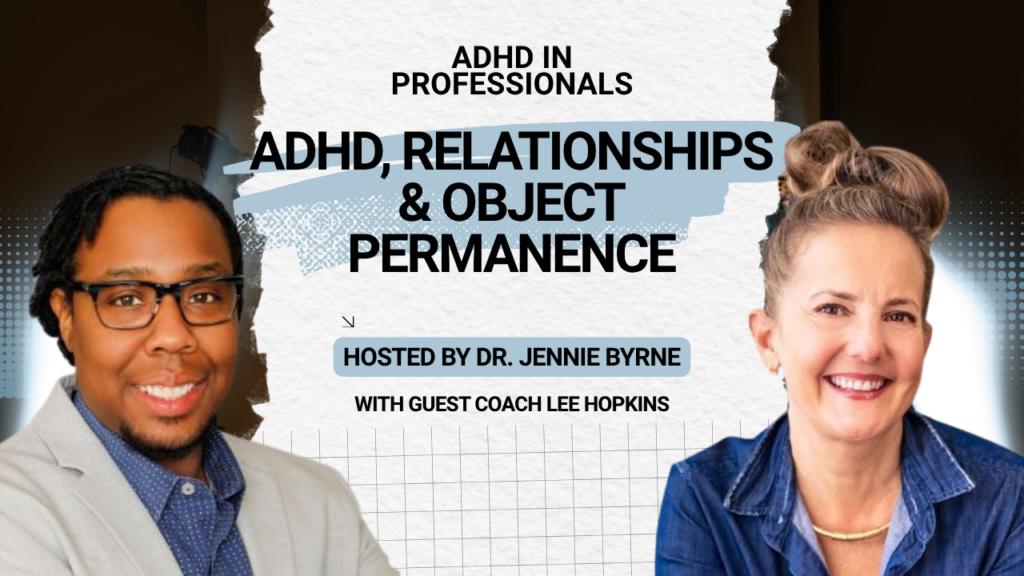
Coach Lee Hopkins has spent years figuring out what actually works — for himself, and for the neurodivergent adults he coaches. He was diagnosed with ADHD as an adult, and shortly after discovered he was also autistic. That combination — which he describes as complete chaos inside his head, the novelty-seeking of ADHD constantly colliding with the structure-craving of autism — gave him a particular understanding of why relationships are so hard for neurodivergent people, and what it takes to build them intentionally.
I sat down with him to talk about object permanence, time blindness, rejection sensitivity, and the thing that nobody tells you about social connection after the formal structures of school and early career disappear.
Why ADHD and relationships are harder as an adult
In school, social connection has built-in scaffolding. You see the same people every day. You have a reason to be in the same room. The relationship builds almost by default.
As an adult, that scaffolding is gone. And for someone with ADHD, several things converge to make the gap even wider.
The interest-based nervous system that makes ADHD brains so alive and engaged when something is new tends to fade as relationships settle into routine. The novelty disappears. The follow-up feels less compelling. And without a natural structure pulling you back into contact with someone, out of sight really does become out of mind.
Layer on rejection sensitive dysphoria — the neurological sensitivity to criticism and perceived rejection that makes ADHD brains register social risk acutely — and you get a pattern that many people recognize immediately: the desperate urge to say the right thing in every interaction, combined with such profound uncertainty about what the right thing is that you end up saying nothing at all. Masking and performing to protect against rejection, and then being too exhausted to actually connect.
Object permanence — and what it means for ADHD and relationships.
Object permanence is a concept most people associate with infant development — the stage when a baby learns that mom leaving the room doesn’t mean mom is gone forever. But the underlying experience of out of sight, out of mind shows up in adult ADHD in ways that directly affect relationships.
You see the text message. You mean to answer it. You close it. And then, genuinely, the person ceases to exist in your active awareness. Not because you don’t care about them — but because your brain doesn’t keep them on the surface when they’re not directly in front of you. Weeks pass. Months, sometimes. And then suddenly they resurface and you feel the weight of the gap you’ve let open.
Coach Lee’s solution is structural and honest: he tells people upfront that his phone is on do not disturb, and that he reserves a specific window — 12 PM to 1 PM — for responding to messages. The relationship expectation is set before the gap happens. People know he’ll come back. And he builds in the intentional time to actually do it.
History, hobbies, and habits.
Before the question of how to maintain relationships is the question of where to find them — and Coach Lee has a framework for this that’s more useful than the generic “get out there” advice.
Three anchors: history, hobbies, and habits.
History is the shared experience that makes someone immediately relatable — where you grew up, how you were raised, the things that shaped you. Hobbies are what you actually enjoy doing, and the key is to go to the places where those things happen — not to network, but to be genuinely in your own environment, which makes conversation natural rather than performed. Habits are the rhythms of your actual life — when you get up, how you eat, what your days look like — which signal compatibility more accurately than any profile or first impression.
The point isn’t to manufacture connection. It’s to put yourself in situations where connection can happen authentically, with people whose lives actually overlap with yours in some meaningful way.
Time blindness and the year board.
Time blindness — the ADHD experience of time as now and not now, rather than as a continuous spectrum — affects relationships in ways that are easy to underestimate.
Everything that isn’t happening right now exists in an undifferentiated “later” that never quite arrives. The person you meant to call last month, the friend you’ve been meaning to check in with, the relationship you keep planning to invest in — they all live in the same formless not-now.
Coach Lee showed me his solution during our conversation: a giant physical board, mounted on his wall, showing every month of the year. A visual external reminder that time is actually passing — that it’s July, not March, and that he hasn’t spoken to certain people in longer than he realized. It looks big. It might look silly to some. He’s aware of that. He uses it anyway because it works.
One of my patients used something similar — large custom-made journals where he would draw and color-code each day, creating a visual record of his life that let him see progress in a way that the ADHD experience of perpetual now couldn’t provide. When everything feels like an undifferentiated present, a visual record of the past becomes genuinely useful. Not as nostalgia, but as evidence that things are actually moving forward.
What to do when you blow it.
This is the part of the conversation I think most people with ADHD need to hear.
Because the object permanence issue and the time blindness issue mean that relationships will sometimes lapse. Texts will go unanswered for weeks. Appointments will be missed. People you care about will be left wondering if you care at all. And when you realize it’s happened, the shame spiral can feel like enough of a reason not to try to fix it.
Coach Lee’s reframe: separate the shame from the lesson. The thought pattern that says “I didn’t follow up, they don’t like me, I’m the kind of person who can’t maintain relationships” — that’s shame talking. The more useful reframe is: this is a pattern that comes with how my brain works, and I need a better system. What’s the next step?
The next step is usually a direct, honest conversation with the person. Most people who genuinely want connection with you will understand communication preferences, will understand that sometimes you disappear, and will understand that it has nothing to do with how you feel about them — if you tell them. The conversation has to happen. But it’s far more likely to go well than the shame spiral suggests.
For the people on the other side of this.
This conversation isn’t only for neurodivergent people. It’s for the partners, the parents, the colleagues, the friends who are on the other side of an ADHD brain and trying to figure out how to connect.
What Coach Lee recommends — and what my experience as a parent confirms — is patience and curiosity rather than interpretation. When communication feels off, when someone goes quiet, when the tone gets misread and someone shuts down — the instinct to interpret that as a statement about the relationship is almost always wrong. The interpretation is about the neurodivergent brain, not about you.
What helps is exactly what Coach Lee described: meeting the person where they are, figuring out together what works, and being willing to try things that might feel unusual. My household emails its teenager. It felt bizarre at first. It works.
The real takeaway.
Coach Lee ended with something worth sitting with: healing from the relationship patterns that ADHD creates doesn’t mean trying harder. It doesn’t mean commanding yourself to be on time, to follow up, to pay attention. Those commands don’t work because the problem is neurological.
What works is building external systems that compensate for the internal ones that don’t function the way the social world expects. And being honest with the people in your life about what those systems look like, so they can work with you instead of against you.
If you’re a professional with ADHD and relationships are something you struggle to navigate, but you haven’t been fully assessed, understanding your brain is the foundation everything else gets built on. Reach out via the contact form at constellationpllc.com.
And if relationship coaching specifically is what you need, Coach Lee’s work is exactly right for neurodivergent adults trying to build connection that lasts.
📌 Grab your copy of ADHD in Professionals: Embrace Your Brain HERE.
📌 Coach Lee Hopkins — Patterns of Possibility: patternsofpossibility.com
📌 Social Connection Summit: socialconnectionssummit.com
📌 Constellation PLLC: constellationpllc.com
Dr. Jennie Byrne, MD, PhD is a neuroscientist, psychiatrist, and author whose work explores human behavior, mental health, and ADHD in high-achieving adults. In her latest book, “ADHD in Professionals: Embracing Your Brain,” she offers an honest, empowering look at how ADHD shows up in physicians, executives, entrepreneurs, and other professionals—and how they can better understand and work with their brains.
A board-certified psychiatrist with an MD/PhD in neuroscience, Dr. Byrne has built her career at the intersection of clinical care, leadership, and innovation. She is known for her clear, pragmatic voice on topics including ADHD, burnout, stigma, and the future of mental health care.
Dr. Byrne is also a sought-after speaker and thought leader committed to helping professionals navigate mental health with insight, candor, and compassion. Learn more at www.constellationpllc.com.