
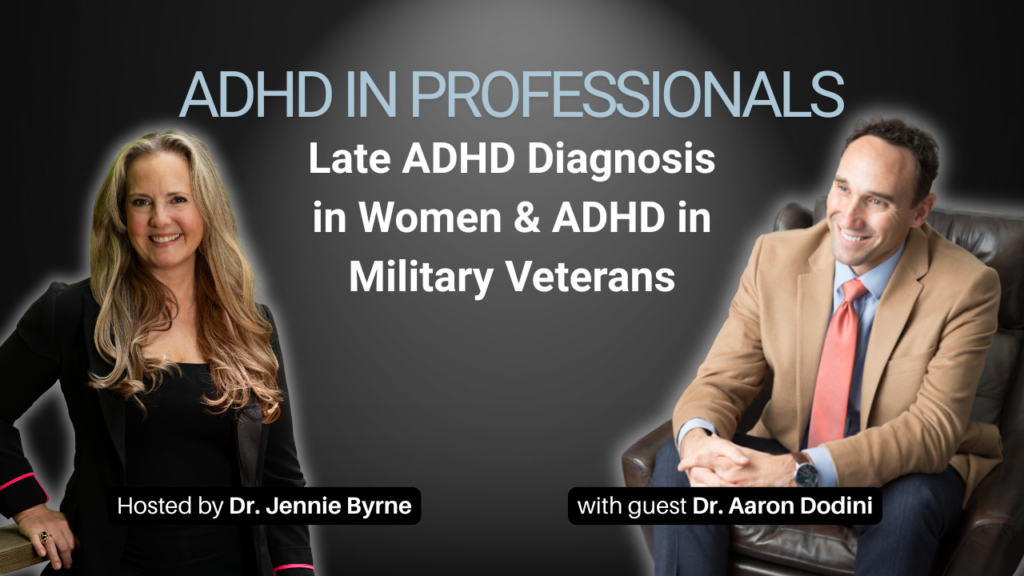
Adult ADHD is the second most prevalent behavioral health condition in the country. And yet it remains simultaneously overdiagnosed and underdiagnosed — not because the science isn’t there, but because we’re not always doing the assessment the right way, or asking it of the right people.
I sat down with Dr. Aaron Dodini — clinical psychologist, marriage and family therapist, and founder of Dodini Behavioral Health and Axon ADHD — to talk about two populations that consistently fall through the cracks: high-achieving women getting late-life diagnoses, and military service members transitioning into civilian life.
These aren’t edge cases. They’re patterns Aaron and I both see constantly in our clinical work. And the consequences of missing them are real.
Why late ADHD diagnosis keeps happening in women.
The historical framing of ADHD as a condition affecting hyperactive boys didn’t just shape clinical training — it shaped the entire diagnostic culture around who gets assessed and who doesn’t. Girls who were inattentive, high-achieving, and quietly compensating didn’t fit the picture. So they didn’t get identified. They got labeled anxious, or sensitive, or — as they hit perimenopause — told that what they were experiencing was hormonal.
What Aaron and I both see in clinical practice is something more specific: high-functioning women who have been extraordinarily successful for decades, running on systems held together by anxiety rather than genuine ease. Everything looks fine on the surface. Underneath it, the cortisol has been elevated for years. The self-doubt has been running on a loop for so long it sounds like a personality trait. The rigidity that made them effective has become a wall between them and anything that actually feels good.
Aaron described it precisely — these are women who’ve forgotten how to have fun. When he asks patients to name their core values, they say things like “hardworking” and “successful.” When he asks them to describe a moment of genuine joy, different words emerge: creative, easy, alive. The gap between those two sets of words is the cost of decades of anxiety-driven achievement.
And then perimenopause arrives. Estrogen drops. The coping mechanisms that carried them through their thirties and forties stop working. They come in finally asking what’s actually happening in their brain — and for the first time, someone gives them a real answer.
How objective testing changes late ADHD diagnosis.
Both Aaron and I use objective attention testing alongside clinical interviews and standardized rating scales — and the reason isn’t just clinical rigor. It’s what the data does for the person sitting across from you.
By the time someone reaches a late-life diagnosis, they have usually spent decades doubting themselves. Maybe I’m just lazy. Maybe I’m just not that smart. Maybe I’m exaggerating. That self-doubt isn’t a personality trait — it’s the accumulated residue of an undiagnosed brain that couldn’t predict or control its own variability. When you’re never sure whether today will be a high-performance day or a barely-functional one, and you can’t explain why, the most available explanation becomes: something is wrong with me.
Objective data breaks that loop. When someone can see in black and white what their brain is actually doing — how it responds to stimuli, how consistently it tracks, how it compares to a normative group — the self-doubt has something concrete to argue with. The relief is immediate. Sometimes there’s grief alongside it: if only I’d known 40 years ago. But the relief is real, and it’s the starting point for building something different.
As Aaron put it: ADHD isn’t an attention problem, it’s an identity problem. How someone views themselves, what they believe they’re capable of, what they’ve spent decades proving to themselves — that’s what’s actually being treated. The data is the first piece of evidence that the story they’ve been telling might not be accurate.
The military transition — and why it’s a crisis hiding in plain sight.
This is the part of our conversation I haven’t had with anyone else in this series, and I think it deserves direct attention.
A three-star general told Aaron that he wouldn’t be surprised if 85% of his soldiers had ADHD. That number is striking — but when you understand the path, it makes sense.
A significant proportion of people who enter military service were told in school that they weren’t college material. They were distractible, restless, problematic in classrooms. The military gave them something school didn’t: structure. Clear hierarchy, explicit expectations, physical demand, high-stakes environments where the ADHD brain’s sensitivity and reactivity became genuine assets. Their esteem grew. They trusted themselves. They discovered they could do hard things.
And then they transitioned out.
When that happens, they lose the structure simultaneously with the identity — I’m a soldier, a leader, a person who belongs somewhere. They often carry trauma from what they experienced in service. They come into civilian life without the support systems that were woven into their daily existence, and without a diagnosis that would help them understand why civilian environments feel so destabilizing.
Untreated ADHD carries a five-times higher rate of depression, anxiety, and substance use. Life expectancy decreases by seven years. Suicidality rates are significantly elevated in untreated ADHDers who also carry trauma and lack support systems. When you put all of that together with the military transition — the identity loss, the structural vacuum, the undiagnosed neurology, the trauma — the risk compounds fast.
Aaron shared the story of a veteran who came to him depressed, drinking too much, on the edge of losing his marriage. Exceptional mechanic, world-class technical skills built over years of service. He couldn’t translate those skills into a functioning civilian business because the executive function piece had never been addressed. Once the diagnosis was made and the support was in place, the progress was fast. Two years later: his own shop, successful business, stable family, off the edge entirely.
That’s not an outlier. That’s what happens when the right intervention finds someone at the right time.
Aaron has been doing advocacy work on Capitol Hill around this — pushing for systematic ADHD screening at the point of military transition, before people leave the structure that’s been holding them. Congressional staffers were asking smart questions: not what is ADHD, but how do we diagnose it more efficiently, how do we get support systems in place, what do we do about the stimulant classification issue. The conversation has shifted. Whether the policy follows is still an open question.
What real clarity actually looks like.
The thread connecting both of these populations — late-diagnosed women and transitioning veterans — is the same: once the identification happens, and the right support follows, the progress is often faster than anyone expects.
These are people who have been capable all along. They’ve been doing extraordinarily hard things in environments that weren’t built for their brains. When you give them a framework that actually fits, and tools that actually work, and a structure they can own rather than one imposed on them — they run with it.
That’s not a treatment outcome. That’s a person finally operating at their actual capacity.
If you’re a professional wondering whether your experience has a name — or if you know a veteran who is struggling with the civilian transition — an assessment is where clarity starts.
Constellation PLLC offers comprehensive ADHD assessments across 25 states. Reach out via the contact form at constellationpllc.com.
And for fast, virtual ADHD assessment, Dr. Aaron Dodini’s platform Axon ADHD offers a free screening and full evaluation within days.
Grab your copy of ADHD in Professionals: Embrace Your Brain here: https://www.amazon.com/ADHD-Professionals-Embracing-Your-Brain/dp/B0GZVBDQQH/
📌 Axon ADHD — Dr. Aaron Dodini: axonadhd.com
📌 Dodini Behavioral Health: https://dodini.com/
📌 Constellation PLLC: constellationpllc.com
Dr. Jennie Byrne, MD, PhD is a neuroscientist, psychiatrist, and author whose work explores human behavior, mental health, and ADHD in high-achieving adults. In her latest book, “ADHD in Professionals: Embracing Your Brain,” she offers an honest, empowering look at how ADHD shows up in physicians, executives, entrepreneurs, and other professionals—and how they can better understand and work with their brains.
A board-certified psychiatrist with an MD/PhD in neuroscience, Dr. Byrne has built her career at the intersection of clinical care, leadership, and innovation. She is known for her clear, pragmatic voice on topics including ADHD, burnout, stigma, and the future of mental health care.
Dr. Byrne is also a sought-after speaker and thought leader committed to helping professionals navigate mental health with insight, candor, and compassion. Learn more at www.constellationpllc.com.