
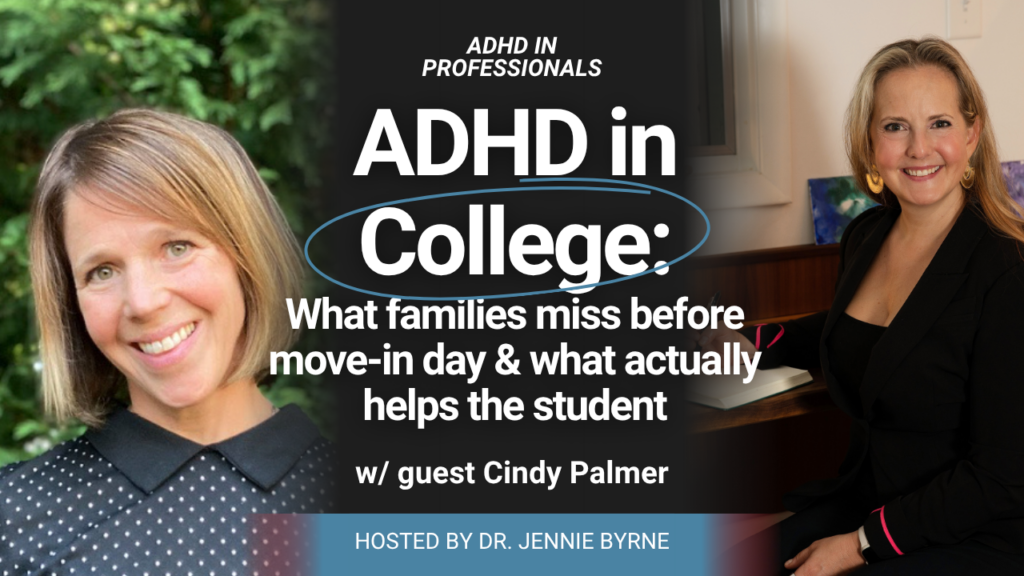
Most families spend months preparing for the college transition. Bedding, laptops, meal plans, orientation schedules. And then the week before move-in, someone realizes they haven’t figured out what happens when their kid runs out of ADHD medication two states away from home.
I sat down with Cindy Palmer — therapist, former high school educator, founder of Threshold Coaches, and a later-in-life ADHD diagnosis herself — to talk about what actually goes wrong when kids have to navigate ADHD in college, what families can do about it, and what it looks like when a brain finally finds the work it was made for.
The medication problem nobody prepares for.
Stimulant medications are controlled substances. That single fact creates a cascade of logistical challenges that most families don’t anticipate until they’re in the middle of a crisis.
A college student can only get a month’s supply at a time — sometimes. Insurance may allow 90 days; the pharmacy may not fill it. When a student moves to a different state, their current prescriber may not be licensed there. When the pharmacy runs out of stock — which happens more than people realize — the student has to navigate a multi-step process of calling multiple pharmacies, coordinating with their doctor, and finding a solution. For a brain that was already struggling with executive function under normal circumstances, doing this under the stress of finals week is genuinely incapacitating.
Cindy described a student who came to her a week before finals, three days without medication, hadn’t slept in 36 hours, convinced he simply couldn’t get it and therefore had no options. She ended up calling pharmacies herself. What started as coaching became crisis intervention.
The solution is preparation that starts earlier than feels necessary. Ideally, with students who are juniors or seniors — before the adrenaline of imminent departure makes executive function collapse entirely. The checklist: talk to the current prescriber about their cross-state policies, get on wait lists for providers in the college’s city six months in advance, request a 90-day supply before departure if insurance allows, and know exactly which questions to ask the university health center when you arrive.
If you’re reading this a week before move-in: call the university health center first. Ask specifically whether they handle medication management on campus. Ask for their referral list of outside providers. And call the current prescriber to see if they’ll fill early given the transition — in my experience, when you explain the situation honestly, most will work with you.
The diagnosis that almost didn’t happen.
Cindy’s own story is one I’ve heard versions of hundreds of times. Her nickname in sixth grade was Little Spaz — it was on the back of a sweatshirt. She got a C in conduct in first grade. Looking back, the markers were everywhere. But inattentive ADHD in girls doesn’t disrupt classrooms. It doesn’t get flagged. It gets called personality, or anxiety, or just the way she is.
She was over 50 when it clicked. Hormones shifted. Life got bigger. She was immersed in ADHD training for her coaching work and kept recognizing herself in the clinical literature. Genetics ran in her family. Everything pointed in the same direction.
She went to her GP, filled out a 10-question questionnaire, and got a diagnosis in one appointment. She was the first to say that wasn’t a full workup — and it’s still on her bucket list. The cost and complexity of a thorough assessment is a real barrier for a lot of people, and I want to name that honestly. But even an incomplete picture gave her something she hadn’t had before: a framework for understanding why she works the way she does.
The example she gave was latency. She’s often a few minutes late. She used to read that as being inconsiderate, irresponsible, a character flaw. What she understands now is that she was waiting until the last possible moment because that’s when enough adrenaline kicks in to actually complete the tasks before leaving. Her brain needs the deadline pressure to engage. The latency was a symptom, not a personality failing. That reframe — from character flaw to neurological reality — is often what changes everything.
What gets missed when facing ADHD in college
Cindy’s clinical experience with college students mirrors what I see in my adult practice: overdiagnosis and underdiagnosis happening simultaneously, often in different populations.
What gets missed most consistently is high-achieving girls and women who have been carrying ADHD under a diagnosis of anxiety or depression. The anxiety is real — but it’s often downstream of an ADHD brain that has never been properly supported. The ADHD is the bottom layer that needed to be found first. The student Cindy described that week — 21 years old, IQ off the charts, straight A’s in high school, now struggling in college and watching peers do things faster and easier — is the pattern I see constantly. The structure of high school carried them. College removed it. And the gap between capacity and output suddenly became visible.
What occasionally gets overdiagnosed: students who self-identify based on social media content and complete a questionnaire with the answers they know are expected. This is less common than critics suggest, but it’s real. A proper assessment — one that includes multiple data sources, a full history, and objective testing — is the protection against both directions of error.
Non-stimulant options most people don’t know about.
One of the things I see consistently is that people — students, parents, and sometimes clinicians — think stimulants are the only option. They’re not.
Non-stimulant medications exist and work well for certain presentations, particularly for students who experience significant anxiety alongside their ADHD, or who have had adverse reactions to stimulants. There’s also a newly approved non-stimulant that’s generating clinical interest. Non-stimulants are not controlled substances, which removes the pharmacy logistics problem almost entirely. They target the physiology differently. For the right patient, they can be genuinely transformative.
If a student says “I tried medication and it didn’t work,” that’s not the end of the conversation. It’s the beginning of one about which medication, at what dose, for what specific symptoms — and whether there are other options worth trying.
The most important thing I’d say to parents of kids with ADHD in college.
Cindy ended our conversation on a note I want to amplify directly.
If you’re a parent with a vision for what your child with ADHD in college should do with their life — the career, the major, the path you can see for them — hold that vision loosely. Very loosely.
An ADHD brain that is forced into work it doesn’t care about will underperform, struggle, and potentially fail. The same brain, pointed at something it’s genuinely passionate about, can do things that look extraordinary to everyone watching. The difference between those two outcomes is often whether the person got to choose.
Cindy estimated that 75% of the time, there’s a meaningful mismatch between what parents hope for their ADHD student and what the student actually needs to thrive. That mismatch doesn’t just affect grades. It affects the relationship.
Her own college experience is a perfect illustration. She didn’t read just the assigned textbook — she went to the library and got multiple textbooks on the same topic, because novelty kept her brain engaged and boredom was the enemy of retention. She studied in the quietest possible environment, with maximum sensory control, and maximum intellectual variety. She stumbled into a strategy that worked brilliantly for her specific brain. She also stumbled into a subject she was genuinely passionate about — and that passion carried her through.
That’s not luck. That’s what happens when a brain gets to do the thing it was built for.
If you’re a professional wondering whether this conversation resonates for you — whether the college student described here sounds like you did at that age, or whether Cindy’s reframe of latency as neurology rather than character sounds familiar — an assessment is where that understanding begins.
Constellation PLLC offers comprehensive ADHD assessments across 25 states. Reach out via the contact form at constellationpllc.com.
And grab your copy of ADHD in Professionals: Embrace Your Brain here: https://www.amazon.com/ADHD-Professionals-Embracing-Your-Brain/dp/B0GZVBDQQH/
📌 Threshold Coaches — Cindy Palmer: https://www.thresholdcoaches.com/
📌 Constellation PLLC: constellationpllc.com
📌 Free ADHD resource list: constellationpllc.com/adhd-resources
📌 CHADD medication options resource: chadd.org
Dr. Jennie Byrne, MD, PhD is a neuroscientist, psychiatrist, and author whose work explores human behavior, mental health, and ADHD in high-achieving adults. In her latest book, “ADHD in Professionals: Embracing Your Brain,” she offers an honest, empowering look at how ADHD shows up in physicians, executives, entrepreneurs, and other professionals—and how they can better understand and work with their brains.
A board-certified psychiatrist with an MD/PhD in neuroscience, Dr. Byrne has built her career at the intersection of clinical care, leadership, and innovation. She is known for her clear, pragmatic voice on topics including ADHD, burnout, stigma, and the future of mental health care.
Dr. Byrne is also a sought-after speaker and thought leader committed to helping professionals navigate mental health with insight, candor, and compassion. Learn more at www.constellationpllc.com.