Picture a duck on the water. Calm on the surface. Feet moving furiously underneath.
That’s how Emily Raclaw, licensed professional counselor and certified rehabilitation counselor at Marquette University, describes what it looks like to be a high-masking professional with ADHD. You see someone who has it together. You don’t see what it’s costing them to maintain that appearance — or what happens the moment they stop.
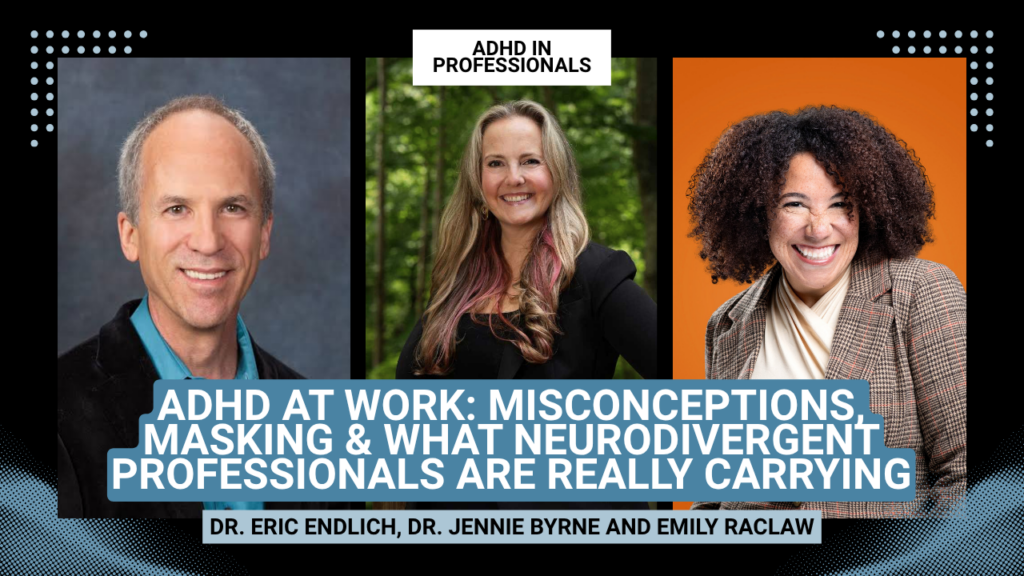
I sat down with Emily and Dr. Eric Endlich, clinical psychologist and founder of Top College Consultants, for a wide-ranging conversation about ADHD in the workplace — the strengths, the misconceptions, the places where the system fails, and what neurodivergent professionals are actually carrying when they walk into a room. Both work at the intersection of neurodiversity, education, and employment, and both bring lived experience to the conversation.
The strength-based approach is valuable — and more complicated than it sounds.
There’s a growing movement toward framing ADHD in terms of strengths — the hyperfocus, the creative problem-solving, the ability to make connections that nobody else in the room is making. Eric and Emily both work from a strengths-based, neurodiversity-affirming framework, and the research supports it: workplaces that embrace genuine diversity — including cognitive diversity — consistently outperform those that don’t.
But Eric raised something worth sitting with: the “superpower” framing can feel like another form of othering. For someone who spent their entire K-12 experience being treated as different, being told they have special powers isn’t always the affirmation it’s intended to be. It can just be another way of being set apart.
Emily’s take cuts even sharper: by age 10, children with ADHD have received roughly 20,000 more negative messages about themselves than their neurotypical peers. Against that backdrop, reframing even one thing as a genuine strength matters — not as a motivational poster moment, but as a real recalibration of a self-concept that has taken years of damage.
The ADHD at work accommodation conversation is more important than most professionals realize.
One of the things both Emily and Eric emphasize with students heading into the workplace is that accommodations don’t end at graduation. They exist in professional settings too — and they exist for a reason that has nothing to do with lowering the bar.
As Eric put it: ADHD accommodations don’t lower the bar. They open the door.
The resistance to this framing often comes from a well-meaning but misguided belief that the professional world is the “real world” where you have to perform without support. But the actual data on workplace accommodations tells a different story — and so does the lived experience of professionals who’ve finally accessed the support they needed and watched their performance improve dramatically as a result.
Beyond the legal and practical benefits, there’s something deeper: knowing yourself well enough to ask for what you actually need is a skill. A hard-won one. And it starts with having language for what’s happening in your brain.
The ADHD at work misconception that does the most damage.
All three of us landed on the same one independently: “You’re too high-functioning to have ADHD.”
Emily described it precisely. The professional who stays up until 3 AM to produce work that looks effortless in the morning. The student getting straight A’s while their parent sits beside them for four hours every night just to make it happen. The executive who crushes every performance review and goes home and collapses. On paper — thriving. Underneath — a duck, feet churning.
What the “too high-functioning” dismissal misses is that masking is a skill, and a costly one. Every unit of energy that goes into performing neurotypicality is a unit that doesn’t go into actual work, relationships, or recovery. The professionals who get dismissed because they look fine are often the ones working hardest of all — they’ve just gotten very good at making it invisible.
As Emily put it: what you really mean is too high-masking. And that’s a very different thing.
Intersectionality: what people carry into the room.
Emily, as a Black woman with ADHD, brought something to this conversation that rarely gets named directly in ADHD discussions. Walking into a professional environment already hyper-aware of how she’s being perceived — for her race, her gender, her neurodivergence — means she’s modulating multiple layers of self-presentation simultaneously before the actual work even begins.
Every additional identity that carries social risk adds to the weight in what she calls the proverbial backpack. The ADHD professional who is also a woman, also a person of color, also navigating a workplace not built for any of those things — the compounding is real, and it has real costs.
This extends to women with ADHD who are also mothers, carrying societal expectations around household management and childcare that are about as mismatched with an ADHD brain as it gets. The laundry, the school forms, the scheduling — these tasks aren’t anybody’s strengths, and women are disproportionately expected to carry them alongside full professional careers.
What actually helps — beyond medication.
When a live viewer asked about non-medication strategies, the answers were practical and specific. Heavy physical exercise — not a casual walk, but the kind that genuinely regulates the dopamine system. Structuring the most demanding cognitive work for the times of day when focus is naturally stronger. Sleep and diet, taken seriously. Technology used intentionally rather than as a distraction generator.
And perhaps most importantly: executive function coaching. Not just handing someone an app and hoping they use it, but actively working with someone who teaches them how to use the tools in context — across different situations, until the tool becomes genuinely integrated into how they operate.
The best tool, as one coach Eric works with puts it, is the one you’re actually using.
Finding the right environment matters as much as developing the right strategies.
Eric’s closing thought is one I’d hand to every professional with ADHD who is grinding through a role that doesn’t fit: the goal isn’t to force a square peg into a round hole. Different neurotypes thrive in different environments. If you’re exhausted and underperforming and nothing seems to be working, the problem may not be your strategies — it may be the environment itself.
Finding the right people, the right setting, the right kind of work — that’s not giving up. That’s self-knowledge in action.
If any of this conversation resonates — whether for yourself, your team, or someone you’re supporting — my book ADHD in Professionals: Embrace Your Brain goes deep on all of it. Order your copy here: https://www.amazon.com/dp/B0GZ12GGTV
📌 Connect with Dr. Eric Endlich: topcollegeconsultants.com
📌 Connect with Emily Raclaw: emily.raclaw@marquette.edu
📌 Job Accommodation Network (JAN): askjan.org
📌 Neurodiversity Employment Network (MENTOR): https://neurodiversityemploymentnetwork.org/
📌 Older Autistic Adults by Dr. Eric Endlich: https://www.amazon.com/Older-Autistic-Adults-Their-Generation/dp/1942197519
📌 Learning from Neurodivergent Leaders: https://www.amazon.com/Neurodiversity-Leadership-Nancy-Doyle/dp/1805011421
What’s the most damaging misconception about ADHD at work you’ve encountered in a professional setting? Drop it in the comments.
Dr. Jennie Byrne, MD, PhD is a neuroscientist, psychiatrist, and author whose work explores human behavior, mental health, and ADHD in high-achieving adults. In her latest book, “ADHD in Professionals: Embracing Your Brain,” she offers an honest, empowering look at how ADHD shows up in physicians, executives, entrepreneurs, and other professionals—and how they can better understand and work with their brains.
A board-certified psychiatrist with an MD/PhD in neuroscience, Dr. Byrne has built her career at the intersection of clinical care, leadership, and innovation. She is known for her clear, pragmatic voice on topics including ADHD, burnout, stigma, and the future of mental health care.
Dr. Byrne is also a sought-after speaker and thought leader committed to helping professionals navigate mental health with insight, candor, and compassion. Learn more at www.constellationpllc.com.