
There’s an aspect of ADHD that doesn’t get discussed in clinical settings as much, because it doesn’t show up in the office. It shows up at dinner. At bedtime. In the car on the way to a weekend soccer game.
The professional is brilliant at work. Decorated, even. They’ve built a career on the very traits their ADHD gave them — the hyperfocus, the intensity, the ability to perform under pressure in ways their colleagues can’t touch. And then they walk through the front door at the end of the day, and something shifts. The fuse is shorter. The patience is gone. They’re saying things to their kids they swore they never would, and they don’t know why.
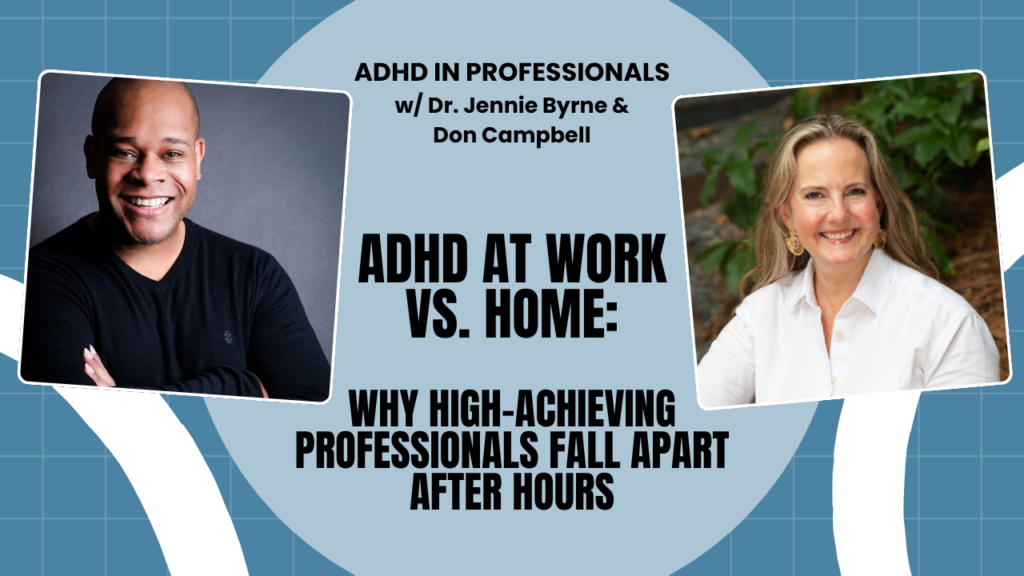
I sat down with Donald Campbell, founder of Soulfire Parenting and a parent coach with nearly three decades of experience, to talk about exactly this. Don works primarily with high-achieving professionals — clinicians, attorneys, business owners, coaches — who are deeply committed to both their careers and their families, and who are quietly struggling to make those two worlds coexist.
The surgeon who can do miracles in the OR and can’t show up at home.
Don shared the story of a surgeon he’d been working with. Combined ADHD, known diagnosis, extraordinarily good at his job. The kind of professional whose ADHD is genuinely an asset in the operating room — the ability to hyperfocus, to tune out everything irrelevant and zero in on what matters, to perform at a level that most people simply cannot.
The problem came when the administrative demands of his role expanded. More documentation. More oversight. More of exactly the kind of sustained, low-stimulation cognitive work that an ADHD brain finds genuinely taxing. He was using enormous mental resources just to get through the parts of his day that had nothing to do with what he was actually there to do. And by the time he got home, there was nothing left.
The weight he was carrying wasn’t about not wanting to be home. It was the accumulated burden of a day spent feeling ineffective — and then bringing that weight into the one place where he most wanted to feel like himself.
As Don put it: he was making his home environment a place he didn’t want to be. And navigating ADHD at home compounded everything.
Why this pattern is so hard to see from the inside.
High-achieving professionals with ADHD are extraordinarily good at pushing through. That’s often how they got where they are. The problem is that pushing through has a cost — and for most of them, the cost gets paid at home, by the people closest to them.
The instinct, Don observed, is almost never to explore what’s changing. It’s to explain it away. I’m just tired. I’m so busy. There’s a lot going on right now. Busy becomes the answer for everything, because busy is socially acceptable in a way that “my brain is struggling with the new demands on it” is not.
By the time someone reaches out for help, the pattern has usually been running for years.
The transition is the hinge point.
One of the most practical things Don and I landed on is the value of the transition — the intentional gap between the professional ADHD self and the ADHD at home self. For an ADHD brain that has been masking, performing, and compensating all day, that transition doesn’t happen automatically. It has to be created.
What it looks like is different for everyone. Sitting in the car for ten minutes before walking in. A meditation practice before rejoining the family. Structuring the most demanding cognitive tasks for the times of day when the brain is actually equipped to handle them. One parent I work with builds a window of time in the middle of her day specifically so she arrives home with something left to give.
Don’s framing for this is useful: like a pitcher who comes up throwing hard and then has to learn — after an injury, after something changes — how to actually pitch. The raw talent was always there. What’s required now is a different set of adaptations. The people who do this well aren’t the ones who push harder. They’re the ones who get curious about how they actually function, and build their life accordingly.
What people say when they finally get the diagnosis.
Don has worked with more than a few colleagues and clients who received an ADHD diagnosis later in life. He’s observed that the response almost always moves through three stages.
First, relief. A lifetime of sensing that something was different — in how they experienced time, relationships, focus, emotion — finally has a name. The diagnosis doesn’t create a problem. It clarifies one that was already there.
Second, grief. For everything that might have looked different if they’d known sooner. The relationships. The career choices. The years spent working twice as hard as everyone around them and assuming the gap was their fault.
And third — the one that Don finds most powerful — hope. Because knowing what you’re dealing with means you can actually do something about it. There’s a path forward that didn’t exist before. A second half worth celebrating.
That arc — relief, grief, hope — is one of the most honest descriptions of what late diagnosis actually feels like that I’ve heard. And it’s why I believe so strongly that getting assessed, even if you never want to take medication, is worth it. Understanding your own brain is the foundation everything else gets built on.
If any of this is landing for you — whether you’re the professional, the partner, or the parent trying to figure out why things feel harder than they should — my book ADHD in Professionals: Embrace Your Brain was written for exactly this situation.
Order your copy here: https://www.amazon.com/ADHD-Professionals-Embracing-Your-Brain/dp/B0GZVBDQQH/
📌 Connect with Don Campbell: www.soulfireparenting.com
Are you a professional navigating the ‘ADHD at work’ to ‘ADHD at home’ transition? I’d love to hear what’s worked for you in the comments.
Dr. Jennie Byrne, MD, PhD is a neuroscientist, psychiatrist, and author whose work explores human behavior, mental health, and ADHD in high-achieving adults. In her latest book, “ADHD in Professionals: Embracing Your Brain,” she offers an honest, empowering look at how ADHD shows up in physicians, executives, entrepreneurs, and other professionals—and how they can better understand and work with their brains.
A board-certified psychiatrist with an MD/PhD in neuroscience, Dr. Byrne has built her career at the intersection of clinical care, leadership, and innovation. She is known for her clear, pragmatic voice on topics including ADHD, burnout, stigma, and the future of mental health care.
Dr. Byrne is also a sought-after speaker and thought leader committed to helping professionals navigate mental health with insight, candor, and compassion. Learn more at www.constellationpllc.com.