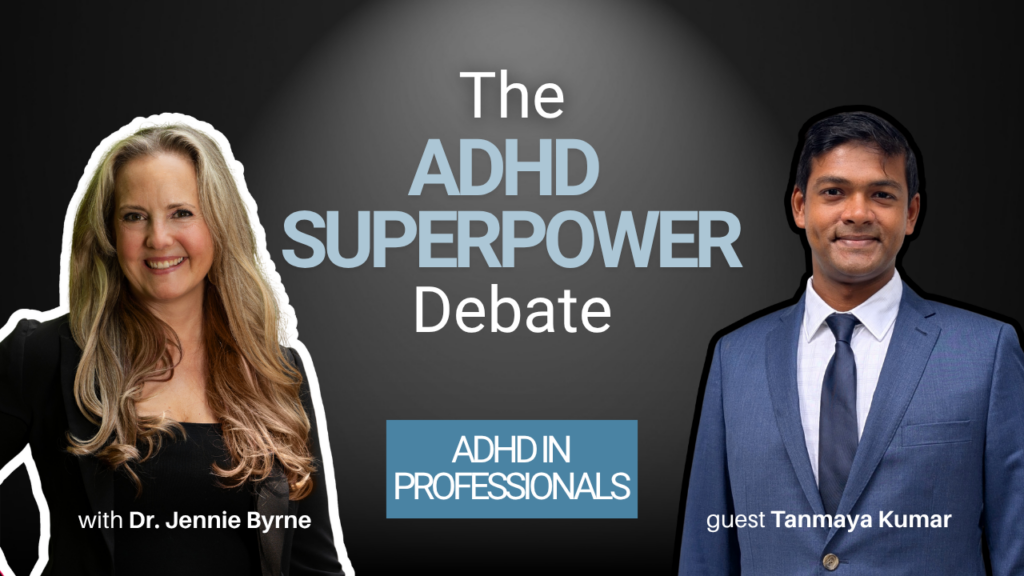
The first line of Tanmaya Kumar’s book rejects the idea of an ADHD superpower entirely.
Mine leans into strength.
That tension — and the conversation it opened up between us — turned out to be one of the more honest exchanges I’ve had about what it actually means to have an ADHD brain in a professional world that wasn’t built for it.
Tanmaya is a technologist and healthcare builder who has spent fifteen years building clinical programs and engineering teams at scale. He’s also the author of Leading Divergence — a book about what it looks like to lead when your brain works differently, both as the neurodivergent person in the room and as the leader of teams that include neurodivergent people. He has ADHD, was diagnosed at nine, went untreated for years, and properly diagnosed and treated in his early thirties.
We had a lot to talk about.
The ADHD superpower framing isn’t wrong, it’s simply incomplete.
When I lean into strength-based language around ADHD, what I’m trying to do is give people a vision of what thriving looks like. The research is clear: ADHD brains, in the right environment, bring things to a team that other brains genuinely cannot. The ability to read a room in real time. Creativity that arrives sideways. Hyperfocus that exceeds what most people can access. Dot-connection that nobody else in the meeting is doing.
Tanmaya’s pushback was precise: those skills are real, and they’re earned. But the systems that surround us — the performance review structures, the promotion criteria, the professional cultures that reward grinding at the expense of rest — were built for a different shape of brain. The ADHD professional has often sharpened themselves into something that looks like a superpower. But the sharpening happened because the system forced it. And that process has a cost that the ADHD superpower framing conveniently leaves out.
He described it as a sine wave. The delivery isn’t always at the peak. There are troughs. And in workplaces that aren’t built to understand that pattern, the troughs get noticed and the peaks get taken for granted.
That’s not a superpower. That’s a person working extraordinarily hard in a system that wasn’t designed to support them.
The disorder label cuts both ways.
This is a tension I sit with clinically, and the conversation with Tanmaya surfaced it clearly.
Some people find the disorder label genuinely useful. It validates the challenges. It opens the door to treatment, accommodations, resources. It gives them permission to stop blaming themselves for things that have a neurological explanation.
Others get stuck in it. The label becomes an identity — a sick person, a broken person, someone who can’t — and it becomes harder to see the path forward. I’ve watched patients get so identified with the disorder framing that they can’t access their own capacity.
Tanmaya’s experience was somewhere in the middle. Diagnosed at nine, a fidgety, hyperfocused kid in India who knew every bird species and its nesting habits — which his environment read as weird and his brain read as intensely interesting. His parents chose not to pursue treatment, wanting to protect him from the stigma of the label. So he did what a lot of ADHD people do: he built masking habits, found environments that rewarded his output — college, early career — and kept running until the systems stopped rewarding the running.
The question isn’t whether the label is good or bad. The question is what you do with it, and whether the environment around you is capable of responding to it with any real intelligence.
Psychological safety is not a soft concept.
The part of this conversation I found most practically valuable was Tanmaya’s description of what it actually looks like to build psychological safety as a neurodivergent leader.
He doesn’t hide. When he’s having a hard day — three hours of sleep, fifteen simultaneous projects, a brain that isn’t tracking at its usual pace — he tells his team. Not with excessive detail, not as an apology, but as information. I’m struggling today. You may need to repeat yourself. I won’t commit to something I can’t deliver.
That transparency isn’t weakness. It’s the foundation of a team that can actually function. When the leader is honest about their own variability, it signals that variability is human, that performance isn’t expected to be a flat line, that people can bring their real selves to work without the constant overhead of performing consistency they don’t have.
He also draws a clear line on meetings: twelve hours of meetings is not productivity. It’s brain death. He protects his own cognitive capacity by being deliberate about when he’s available, cutting off at a certain point in the day, taking walks, coming back. And he extends that same autonomy to his team — nobody asks permission to take time off. They inform him. The ownership belongs to the person doing the work.
These aren’t ADHD accommodations. They’re good leadership practices that happen to create environments where ADHD brains — and all brains — can function better.
Why healthcare systems still fail to screen and treat ADHD.
This is the part of the conversation that frustrates me most, and I suspect always will.
I’ve been working to bake ADHD screening and treatment into clinical programs for twenty years. And it is still, consistently, the hardest thing to get healthcare companies and primary care systems to take seriously. Not because the evidence isn’t there. Not because the need isn’t clear. But because ADHD carries a stigma that depression and anxiety have largely managed to shed.
We talk about depression now. We talk about anxiety. Those conversations have become normalized in professional settings, in clinical workflows, in benefit offerings. ADHD hasn’t gotten there yet. The complexity of the diagnosis — the way it presents differently in different people, the way it overlaps with other conditions, the way the definition has continued to evolve — makes healthcare systems hesitant. And the stimulant association adds another layer of institutional nervousness.
Tanmaya’s read on it: the stigma is still there, it’s just gotten slightly less visible over the last five years. The systems haven’t caught up. And until they do, the people who need screening are going to keep falling through the gaps — particularly in settings where their presentation doesn’t fit the obvious checklist.
That’s why books exist. That’s why conversations like this one exist. And that’s why, if you’re sitting with the question of whether your own experience has a name, the answer is worth finding out.
If you think you might have ADHD, don’t wait for the system to find you. Reach out via the contact form at constellationpllc.com. And if you’re looking for a book that goes deep on what it means to lead as a neurodivergent professional, Tanmaya’s Leading Divergence is worth your time.
📌 Order your copy of ADHD in Professionals: Embrace Your Brain here: https://www.amazon.com/ADHD-Professionals-Embracing-Your-Brain/dp/B0GZVBDQQH/
📌 Tanmaya Kumar — Leading Divergence: https://us.amazon.com/Leading-Divergence-Field-Neurodivergent-Leadership/dp/B0GZK2PS65
📌 Tanmaya on LinkedIn: https://www.linkedin.com/in/tanmayakumar/
📌 Constellation PLLC: constellationpllc.com
Where do you land on the ADHD superpower debate — and does the framing actually matter for how you experience your ADHD at work? Drop it in the comments.
Dr. Jennie Byrne, MD, PhD is a neuroscientist, psychiatrist, and author whose work explores human behavior, mental health, and ADHD in high-achieving adults. In her latest book, “ADHD in Professionals: Embracing Your Brain,” she offers an honest, empowering look at how ADHD shows up in physicians, executives, entrepreneurs, and other professionals—and how they can better understand and work with their brains.
A board-certified psychiatrist with an MD/PhD in neuroscience, Dr. Byrne has built her career at the intersection of clinical care, leadership, and innovation. She is known for her clear, pragmatic voice on topics including ADHD, burnout, stigma, and the future of mental health care.
Dr. Byrne is also a sought-after speaker and thought leader committed to helping professionals navigate mental health with insight, candor, and compassion. Learn more at www.constellationpllc.com.