
Boys get diagnosed with ADHD at an average age of seven.
Girls get diagnosed at twelve. Sometimes later. Often much later — in their thirties or forties, after a child of their own gets diagnosed and something clicks.
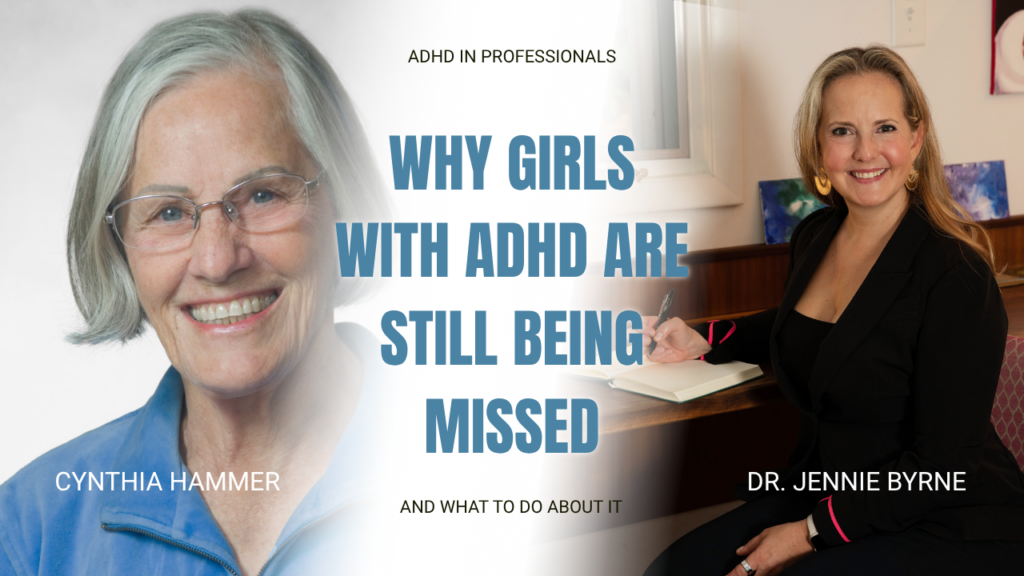
That gap — five years on average, but often decades in practice — is exactly what Cynthia Hammer has spent the last several years trying to close. Cynthia is a social worker who found out she had ADHD at 49, founded two nonprofits as a result, and most recently launched Find the ADHD Girls, a project of the Inattentive ADHD Coalition focused specifically on identifying girls between the ages of five and ten.
I sat down with her to talk about why the gap persists, what masking looks like in a child, and why the most important thing a parent of an ADHD child might do is get themselves assessed.
Why girls with ADHD are still getting missed — even in 2026.
The short answer is culture. And masking. And the fact that for decades, our entire clinical understanding of ADHD was built on research conducted primarily with hyperactive boys.
Girls with ADHD — particularly girls with the inattentive type — don’t tend to disrupt classrooms. They stare out windows. They daydream. They forget things. They struggle quietly with the kind of sustained, executive-function-heavy tasks that school increasingly demands as children get older. None of that gets a teacher’s attention the way a child who can’t sit still does.
And then there’s the masking.
Research by Dr. Lotta Borg Skoratid suggests girls start learning how to mask as early as age three. By that age, many girls with ADHD have already figured out what the social environment rewards and are working — often unconsciously — to perform it. They bite the inside of their cheeks to keep themselves still. They study the room and mirror what earns approval. They become very good at looking fine.
The result is that by the time they reach a clinician’s office, the very behaviors that might trigger recognition have been suppressed for years. And some clinicians respond to this by suggesting the girl was masking all along — as if the masking is her fault rather than a predictable response to an environment that never made it safe to be otherwise.
Cynthia’s response to this: stop waiting for girls to unmask on their own, and start educating parents about what masking looks like so they can ask better questions. The Find the ADHD Girls checklist — built on DSM-5 criteria, the DEVA, and clinician input — is designed to do exactly that. It takes less than ten minutes, and it gives parents language for behaviors they might be seeing but not connecting to ADHD.
Why inattentive ADHD is especially easy to miss.
ADHD presents in different ways. The combined type — inattentive symptoms plus hyperactive and impulsive symptoms — is what most people picture when they hear the word. The inattentive type has none of the hyperactivity, none of the impulsivity that tends to draw attention. It’s internal. Invisible. And it affects girls disproportionately.
Boys with the inattentive type also go undiagnosed at high rates — the diagnosis gap isn’t purely about gender, it’s about presentation. But girls carry an additional layer of social pressure to be quiet, to be compliant, to be the kind of child who earns being called a good girl. That pressure creates a powerful incentive to suppress the very behaviors that might get them seen.
By the time executive demands increase — at the middle school transition, at the start of a career, during pregnancy, during perimenopause — the gap between what’s happening underneath and what people see on the surface can be enormous.
The self-identification question.
Cynthia raised something worth sitting with: the question of whether a formal diagnosis is the only legitimate pathway to understanding your own brain.
Her position, and I find it reasonable: for adults who can’t access or afford a formal assessment, self-identification is a meaningful step. It gives people language. It opens the door to strategies and resources that can genuinely help. And it removes the diagnostic process as the only gatekeeper to permission — the permission to try things that work, to forgive yourself for things that haven’t, to understand that the way your brain operates has a name.
My clinical caveat is real but narrow: not everything that looks like ADHD is ADHD. I’ve worked with women — particularly perimenopausal women — who self-identified as ADHD and turned out, on full workup, to have hormonal or medical issues driving their cognitive symptoms. Getting a proper assessment rules in ADHD and rules out other explanations. That distinction matters for treatment.
But for people who are in the long queue, who are in healthcare deserts, who are weighing cost against access — understanding yourself is worth something even before you have a formal diagnosis.
The parents who will do everything for their kids — but nothing for themselves.
This is the pattern I see most often in my practice, and I wanted to name it directly.
Parents of ADHD children are extraordinary advocates. They will navigate every bureaucratic barrier, spend money they don’t have, fight with school systems, sit through every evaluation. They will do anything for their child.
And then they sit across from me, clearly self-identifying, clearly describing a lifetime of the same struggles their child is having — and they will not get help for themselves.
Cynthia said it plainly: getting your own ADHD treated makes you a better parent. There is no version of this where you are more available, more consistent, more emotionally regulated for your child when you are white-knuckling your own unaddressed ADHD. The whole family system carries the weight of untreated ADHD — and the whole family benefits when someone in it gets the help they need.
Cynthia’s organization takes the position that when one person in a family is diagnosed, everyone should be screened. That’s not overcorrecting. That’s accurate.
She also said something I want people who are hesitating to hear directly: she has never spoken to anyone who said they were glad they waited.
The cost of not diagnosing girls with ADHD.
There’s a generation of parents who chose not to pursue diagnosis for their children out of a desire to protect them from the stigma of a label. That impulse came from love. And the outcome, for many of those children, was years of building an identity around being the problem — the mess-up, the one who couldn’t quite get it together, the person who was somehow less than.
The diagnosis doesn’t create a problem. It names one that’s already there. And naming it — for a child, for an adult, for yourself — is how you start to address it rather than carry it.
If you’re a parent who suspects your daughter might have ADHD, start with the Find the ADHD Girls checklist. It’s free and takes less than ten minutes.
If you’re a parent who’s been sitting with the quiet suspicion that you might have ADHD too — please don’t wait years the way Cynthia did. The assessment is worth it. Not just for you. For everyone in your household.
Reach out via the contact form at constellationpllc.com to learn more about ADHD assessments at Constellation PLLC.
And grab your copy of ADHD in Professionals: Embrace Your Brain HERE.
📌 Find the ADHD Girls checklist: findtheadhdgirls.org/checklist
📌 Find the ADHD Girls resource library: findtheadhdgirls.org/resource-library
📌 Inattentive ADHD Coalition: https://www.iadhd.org/
📌 Constellation PLLC: constellationpllc.com
If you’re a parent of a girl who was diagnosed late — or a woman who was — what do you wish someone had seen earlier? Drop it in the comments.
Dr. Jennie Byrne, MD, PhD is a neuroscientist, psychiatrist, and author whose work explores human behavior, mental health, and ADHD in high-achieving adults. In her latest book, “ADHD in Professionals: Embracing Your Brain,” she offers an honest, empowering look at how ADHD shows up in physicians, executives, entrepreneurs, and other professionals—and how they can better understand and work with their brains.
A board-certified psychiatrist with an MD/PhD in neuroscience, Dr. Byrne has built her career at the intersection of clinical care, leadership, and innovation. She is known for her clear, pragmatic voice on topics including ADHD, burnout, stigma, and the future of mental health care.
Dr. Byrne is also a sought-after speaker and thought leader committed to helping professionals navigate mental health with insight, candor, and compassion. Learn more at www.constellationpllc.com.