The majority of managers were never trained to lead.
They were great individual contributors, they were visible and because of it, they got promoted. And then, overnight, they were handed a title and responsibility for the well-being and performance of a team of people — with no leadership development, no framework for understanding the humans they were now responsible for, and no tools for navigating the significant range of ways those humans actually think and work.
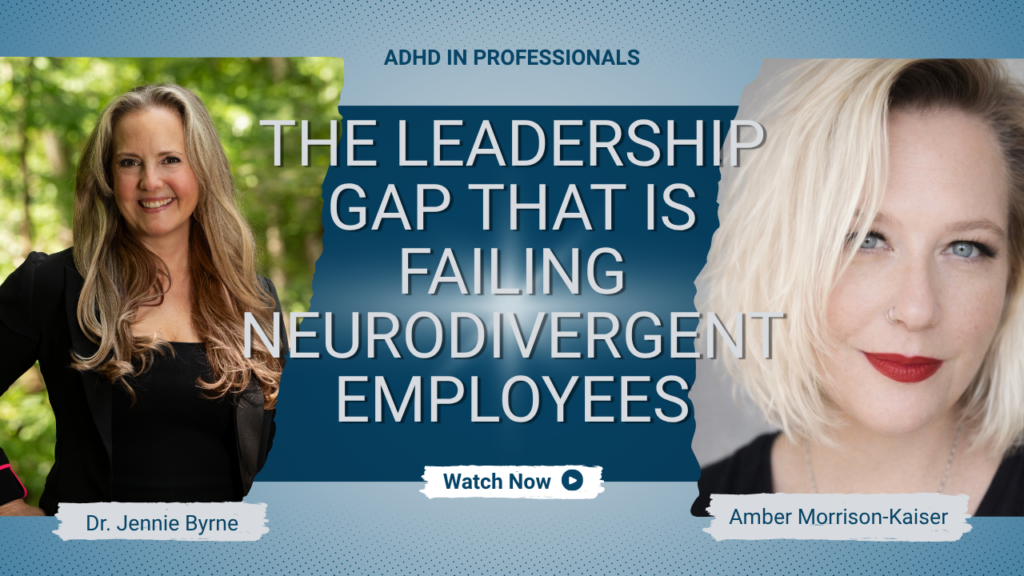
Amber Morrison-Kaiser, PMP, ACP, LSSGB, CSM, CCMP calls this the leadership gap. She’s spent years building the case that it’s one of the most consequential and least-addressed problems in the modern workplace — and that neurodivergent employees carry a disproportionate share of its cost.
I sat down with Amber, a leadership coach and neurodiversity ERG founder who was diagnosed with ADHD in her thirties, to talk about what the leadership gap affecting neurodiverse employees looks like from the inside, what good leadership actually requires, and why getting to know your people is both the simplest and most underestimated leadership practice there is.
How the leadership gap affecting neurodiverse employees shows up.
The pattern is consistent across industries. A high-performing individual contributor does exceptional work, gets noticed, gets promoted. They’re now managing the people they used to work alongside. Nobody has taught them how to lead. Nobody has equipped them to understand that the people on their team have different operating systems — different times of day when they’re sharp, different communication preferences, different needs around environment and structure and how information gets delivered.
For a neurotypical employee with a straightforward manager, this training gap is inconvenient. For a neurodivergent employee — someone with ADHD, dyslexia, autism, or any number of other brain variants — it can be genuinely harmful. When a manager doesn’t know how to ask good questions or create psychological safety, neurodivergent employees don’t disclose. They mask. They build workarounds. They use enormous cognitive resources just to look like everyone else — and they do it alone, because the environment has never signaled that there’s another way.
Universal precautions — and why every leader should use them.
Amber borrowed a concept from healthcare that I found immediately useful: universal precautions. In a clinical setting, universal precautions mean treating every patient as if they carry a transmissible risk, because you often don’t know who does and who doesn’t. The precaution is applied universally, which means nobody slips through.
Her application to leadership is direct: what if every leader simply treated every employee as someone who might have specific needs — around communication, environment, meeting structure, task assignment — and asked the questions to find out?
You don’t have to ask whether someone has ADHD. You don’t have to wait for disclosure. You ask: how do you like to be communicated with? How do you do in meetings where you might be called on without warning? What kind of environment helps you do your best work? Do you need heads-down time, and how much?
These are questions that benefit everyone. They create a workplace where neurodivergent employees can actually tell you what they need without having to attach a diagnosis to the request. And they normalize the conversation enough that disclosure, when and if it happens, doesn’t feel like a risk.
The ERG that became a safe space.
Amber’s path to this work ran through her own company. She founded a neurodiversity Employee Resource Group after recognizing, in herself, the gap between what ADHD was costing her and what the workplace was doing about it. She expected people to show up wanting to educate leadership and push for policy change.
What happened instead stopped her short.
Twenty people signed up on the first day. And they didn’t want to be educated about policy. They wanted a room where they could talk to other people who understood what they were carrying — without anyone outside the room knowing they were there. One of the first members was someone from the DEI team itself. The people responsible for inclusion in the organization were seeking inclusion for themselves in a private space.
That’s the reality of disclosure in most workplaces. The risk feels real because the consequences of disclosing and being met with the wrong response — being seen as less capable, being passed over, being defined by the label — are real. People have experienced them, or watched others experience them.
Amber’s response was to pivot. Instead of using the ERG to push information outward, she focused on building the safe space first. Then, over time, she worked with the learning and development team to bake neurodiversity awareness into the company’s aspiring leaders program — so every manager who came through it had at least a baseline understanding of what leading neurodivergent employees actually required.
That’s how culture shifts. Not through a single announcement, but through embedding the understanding at the point where it can actually change behavior.
What sophisticated workarounds actually cost.
Amber’s description of her own ADHD experience before diagnosis is one I’ve heard dozens of times in my clinical practice, and it’s worth naming directly.
She built elaborate systems — losing her keys consistently enough that she put everything on her phone, using noise-canceling headphones to manage sensory overload, reaching for simple, low-stimulation reading at the end of the day just to let her nervous system recover. She developed a large vocabulary because books were her recovery tool. She ran hard until about 2:30 in the afternoon, burned through everything she had, and had nothing left for the rest of the day — including at home.
None of this was obvious from the outside. From the outside, she was high-performing, organized, effective. The workarounds were invisible. The cost was not.
This is what high-achieving ADHD looks like in practice. The output can look indistinguishable from someone who isn’t working nearly as hard to produce it. And that invisibility is exactly why so many professionals with ADHD get told they can’t possibly have it — or never think to ask.
Getting through the day versus actually thriving.
There’s a distinction I return to constantly in my clinical work, and Amber’s story illustrates it well.
Getting through the day is what the workarounds produce. Thriving is something entirely different. It requires understanding your own operating system well enough to build a life and a career that actually fits it — rather than spending decades forcing your brain into structures designed for someone else’s.
Amber built a business specifically because entrepreneurship gave her the freedom to design her own structure. She knows she burns hot and then burns out, so she protects against it. She leads with people and conversation in the mornings when her brain is at its peak. She guards her afternoons.
That’s not accommodation. That’s self-knowledge applied to professional design.
And it’s available to anyone — but it starts with understanding what’s actually going on in your own brain.
For the leaders reading this.
Amber’s single takeaway to close the leadership gap affecting neurodiverse employees is for anyone in a leadership role to get to know your people. Ask questions. Remove the obstacles that are preventing them from doing their best work. You need to be curious about the human being in front of you — what they need, how they function, what’s getting in their way.
That’s your only job.
And for the neurodivergent professionals reading this: you don’t have to tell your manager your diagnosis, but you can tell them what you need. If you’re a professional wondering whether what you’ve been navigating has a name, an assessment is where you should start. Reach out via the contact form at constellationpllc.com.
And grab your copy of ADHD in Professionals: Embrace Your Brain HERE.
📌 Connect with Amber Morrison-Kaiser, PMP, ACP, LSSGB, CSM, CCMP on LinkedIn
📌 Constellation PLLC: constellationpllc.com
Dr. Jennie Byrne, MD, PhD is a neuroscientist, psychiatrist, and author whose work explores human behavior, mental health, and ADHD in high-achieving adults. In her latest book, “ADHD in Professionals: Embracing Your Brain,” she offers an honest, empowering look at how ADHD shows up in physicians, executives, entrepreneurs, and other professionals—and how they can better understand and work with their brains.
A board-certified psychiatrist with an MD/PhD in neuroscience, Dr. Byrne has built her career at the intersection of clinical care, leadership, and innovation. She is known for her clear, pragmatic voice on topics including ADHD, burnout, stigma, and the future of mental health care.
Dr. Byrne is also a sought-after speaker and thought leader committed to helping professionals navigate mental health with insight, candor, and compassion. Learn more at www.constellationpllc.com.