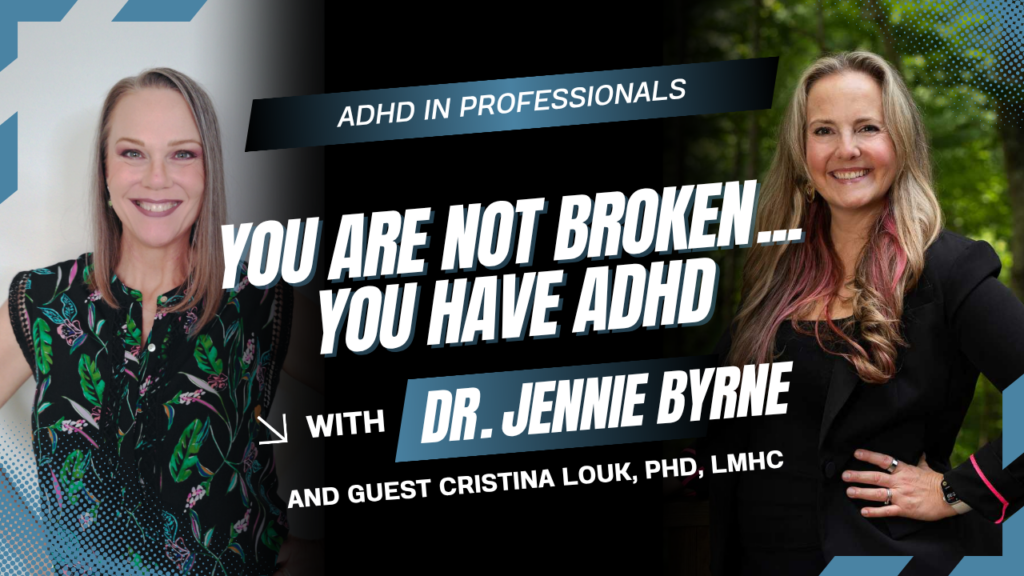
Dr. Cristina Louk had a nickname in sixth grade. She had a C in conduct. She was diagnosed with ADHD as a child, assessed with a high IQ, and still placed in low-level classes for her entire education. A school that knew exactly what her brain was capable of looked at her and decided she didn’t belong in the advanced track.
By the time she graduated, she hated school. She had loved school. That gap — between a child who used to read her father’s psychology textbooks and play teacher with her dolls, and a teenager who felt like she didn’t belong — is what happens when a system can’t see past a label.
Dr. Cristina is now a licensed mental health counselor with a doctorate in clinical psychology, a specialist in ADHD, and someone who walks into every room saying openly that she has ADHD. I sat down with her to talk about the reframe from deficit to difference, why traditional productivity advice backfires for ADHD brains, what leaders can do without requiring anyone to disclose, and why — even in mental health settings — the stigma is often worse than people expect.
The name is the problem
Attention Deficit Hyperactivity Disorder. Dr. Cristina was direct about this: the name itself sets up the pathology. The deficit framing is baked in before anyone even sits down with a patient.
Her position, and mine to reframe ADHD: people with ADHD do not have a deficit of attention. They have a different relationship with attention — one that’s exquisitely responsive to interest, novelty, and urgency, and genuinely resistant to tasks that are low-interest, repetitive, or insufficiently stimulating. That’s not a deficit. That’s a different operating system. One that, in the right environment, produces things that a standard operating system can’t.
Being able to reframe ADHD matters clinically because the internal narrative that patients carry into an assessment has been shaped by the name. I am broken. I am lazy. I am fill in the blank. These aren’t conclusions patients arrived at independently — they were handed to them by a system that framed their brain as deficient and then confirmed it every time the environment didn’t fit.
Changing the language changes what’s possible. Not because words fix neurology, but because the story someone tells about their own brain determines whether they can leverage what it actually does well.
The bucket metaphor — and why sensory management is significant
Dr. Cristina described the ADHD brain as a bucket. Sensory information fills it. When it’s overflowing, nothing new goes in — not tools, not strategies, not any of the productivity advice that people with ADHD are constantly given. The bucket has to have capacity before anything else can work.
This is why she designed her office the way she did: no overhead fluorescent lighting, just lamps and small lights at various heights. Aromatherapy in the corner. A soft sweater within reach for tactile self-soothing. Not luxuries — functional environmental design for a brain that processes sensory input intensely and can be derailed by overstimulation before a conversation even starts.
This principle applies to any workspace. The ADHD brain that’s fighting fluorescent lights, ambient noise, and visual clutter is using cognitive resources just to stay regulated — resources that aren’t available for the work itself. Managing the sensory environment isn’t accommodation. It’s reducing unnecessary overhead so the brain can actually function at capacity.
Why traditional productivity advice backfires for ADHD brains
The standard advice to people who struggle with planning, organization, and working memory is almost always: try harder, be more disciplined, build better habits. The premise is that the solution is internal — something the person needs to generate from inside a brain that is already struggling with exactly that.
Dr. Cristina’s approach is the opposite: externalize everything. If your working memory is poor, carry a notepad. If planning is hard, use a planner. If you can’t track time internally, put clocks on every wall — she has one on every wall of her office, in different styles. Stop trying to do internally what the brain struggles with intrinsically, and find an external system that compensates.
The choice of tool matters less than finding one that fits the specific person. She works with a lot of tech professionals who resist pen and paper — so they build apps instead. What the tool is is less important than whether the person will actually use it and whether it serves the underlying executive function need. The goal isn’t to find the right tool. It’s to find the right tool for this specific brain.
She also made a point worth sitting with: these tools exist to help ADHD brains plug into a neurotypical world. An ADHD brain that has found a way to live successfully on its own terms — working independently, following interest, operating in a low-demand environment — doesn’t need the tools at all. The tools are a bridge between the brain and an environment that wasn’t built for it. When the environment is right, the bridge isn’t required.
What the “sandwiching” strategy actually looks like
One practical technique Dr. Cristina uses with clients: sandwich preferred activities around low-interest tasks.
Every job has tasks that engage an ADHD brain and tasks that don’t. The tasks that don’t — the administrative work, the documentation, the email — feel harder not because the person is less capable but because the interest-based nervous system doesn’t generate the activation to engage with them. Placing a preferred task before and after a low-interest one creates a dopamine buffer. The boring task becomes less daunting because it’s surrounded by things that actually light the brain up.
This is a simple strategy. It’s also one that almost no generic productivity advice suggests — because generic productivity advice wasn’t built for how ADHD brains actually generate motivation.
What leaders can do without requiring disclosure
I hear this question frequently in my practice, and Dr. Cristina named it precisely: neurotypical managers who want to do the right thing often don’t know what that looks like, and their uncertainty results in doing nothing.
Her answer was direct: get neuroaffirming training. Because if the people on your team haven’t told you they have ADHD, it’s not because they don’t — it’s because the environment hasn’t signaled that it’s safe to.
She ran a large agency with twelve case managers and three hundred caregivers. Every meeting had a 30-minute reminder and a 15-minute reminder. Nobody was late. She didn’t ask who had ADHD and who didn’t — she assumed everyone needed the structure, so she built it for everyone. The cost was negligible. The benefit was universal.
Standing desks became standard during the pandemic. She made the observation that stopped me: that’s an ADHD accommodation that neurotypical people were thrilled to receive. Neurotypical colleagues were also helped by it, just without the same stakes attached. Most genuinely neuroaffirming practices work better for everyone. The reason they get framed as special accommodations is that only ADHD brains are penalized visibly when they’re absent.
The stigma problem in healthcare and mental health specifically
This is the part of our conversation I find most frustrating — and most important to address.
I wrote my book in part because I kept watching colleagues I genuinely respected spread misinformation about ADHD without being aware of it. “You’re too high-functioning to have ADHD.” “I can just tell if someone has ADHD — I don’t need to assess them.” These aren’t fringe positions. They come from people with legitimate credentials who simply weren’t trained in this area and don’t know what they don’t know.
Dr. Cristina was discriminated against in a room full of therapists — a trainer walked over and slapped a fidget toy in front of her without asking, in front of all her colleagues. She handed it to the neurotypical colleague beside her, who actually wanted it.
Healthcare and mental health carry, in my experience, more stigma around ADHD than many other professional sectors. Tech has normalized neurodivergence in ways that corporate medicine hasn’t begun to approach. The irony of a mental health professional spreading misinformation about a neurological condition is real, and it compounds the harm for the patients who most need someone to see them accurately.
If you’ve been told you’re too high-functioning to have ADHD, or that your credentials make diagnosis impossible, or that you couldn’t have made it this far with an undiagnosed ADHD brain — please don’t accept that as the end of the conversation. The person who said it may simply not know what they’re talking about.
On medication — a brief word
Dr. Cristina diagnosed primarily as a child, went through her entire PhD unmedicated to prove she could, and went back on medication the day she graduated. That’s not a contradiction. That’s someone who understood exactly what tool she was setting aside temporarily and picked it back up when the context changed.
Medication is one tool. The landscape of options now — stimulants, non-stimulants, medications that address rejection sensitive dysphoria specifically — is significantly broader and safer than it was even twenty years ago. If fear of side effects or past negative experiences is the barrier, those fears are worth revisiting with someone who actually specializes in this.
And if life is going well and the environment fits your brain, you may not need medication right now. That’s not a failure of treatment. That’s the treatment working exactly as it should.
Reach out via the contact form at constellationpllc.com if you’re ready to understand your own brain more clearly.
And if you’re in Washington State, Dr. Cristina Louk offers free consultations at peacehumanistic.com.
📌 Grab your copy of ADHD in Professionals: Embrace Your Brain here.
📌 Dr. Cristina Louk — Peace Humanistic: peacehumanistic.com
📌 Constellation PLLC: constellationpllc.com
📌 Free ADHD resource list: http://www.constellationpllc.com/adhd-resources
Dr. Jennie Byrne, MD, PhD is a neuroscientist, psychiatrist, and author whose work explores human behavior, mental health, and ADHD in high-achieving adults. In her latest book, “ADHD in Professionals: Embracing Your Brain,” she offers an honest, empowering look at how ADHD shows up in physicians, executives, entrepreneurs, and other professionals—and how they can better understand and work with their brains.
A board-certified psychiatrist with an MD/PhD in neuroscience, Dr. Byrne has built her career at the intersection of clinical care, leadership, and innovation. She is known for her clear, pragmatic voice on topics including ADHD, burnout, stigma, and the future of mental health care.
Dr. Byrne is also a sought-after speaker and thought leader committed to helping professionals navigate mental health with insight, candor, and compassion. Learn more at www.constellationpllc.com.